
Everyone is talking about behind-the-meter power. Almost no one is defining it. The phrase has become shorthand for a certain kind of seriousness in AI infrastructure. Say it in a room full of AI leaders and heads nod. But ask what it actually means, mechanically, and where it helps, and the conversation gets vague fast.
That vagueness is a problem, because behind-the-meter is not a buzzword. It is one of the few real answers to the single hardest question in building AI capacity today. That question is not how to find land. It is how to find power. And how to connect it, fast.
Start with the power. Everything else follows.
Land does not let you build anything. You have to have power of some sort, pretty much everywhere. That reordering, power first and land second, is the whole game. It is also where the timeline breaks.
Getting power at the right capacity and quickly is the problem, and the numbers are stark:
- Wait times have more than doubled. In 2024, the average time from an initial interconnection request to commercial operation had risen to nearly five years, compared to under two years in 2008.
- The queue is getting worse, not better. Grid interconnection queues have ballooned to five-year average waits, with transformer shortages adding multi-year equipment backlogs on top.
- In extreme cases it is a decade or more. Companies like Google have reported potential grid connection delays of up to 12 years for new data centers.
- Getting into the queue is not the same as getting through it. Only 13% of the capacity that submitted interconnection requests from 2000 to 2020 had reached commercial operation by the end of 2025.
The queue is no longer a waiting room. For most projects, it is a dead end. So the market is looking for a way around. Behind-the-meter is that way around.
So what does "behind the meter" actually mean?
The utility meter is the boundary between the public grid and your site.
- Grid-connected power is delivered across that meter once the utility has completed the interconnection process and committed the required capacity. That capacity is provisioned for your use, but securing it and bringing it online can take years.
- Behind-the-meter power is generated at or next to the site and consumed directly by the facility, either reducing dependence on the grid connection or operating alongside it.
That single architectural choice changes three things at once:
- Timeline. You are no longer waiting five to twelve years for an interconnection agreement. You generate your own power on site, on your own schedule.
- Politics. Instead of arriving as a new drain on a constrained public grid, competing with households and existing industry for scarce capacity, the facility brings its own power. The message to a community and a regulator shifts from "we need more of your power" to, potentially, "we add power." That is a very different conversation.
- Certainty. Grid-connected projects depend on the utility’s ability to approve, provision and energize the requested capacity. On-site generation provides much greater control over capacity once the necessary permits have been secured.
None of this is exotic. It is increasingly the default posture for serious data center operators:
- The Foley 2026 Data Center Survey found that 56% of developers are exploring co-located or on-site power generation, making it the third most common power strategy behind negotiating PPAs and securing early grid interconnects.
- Industry analysts estimate that 25 to 33% of incremental data center demand through 2030 will be met by behind-the-meter solutions.
Where the power actually comes from
Behind-the-meter is not a single technology but a spectrum of energy options. Reading that spectrum from simplest to cleanest:
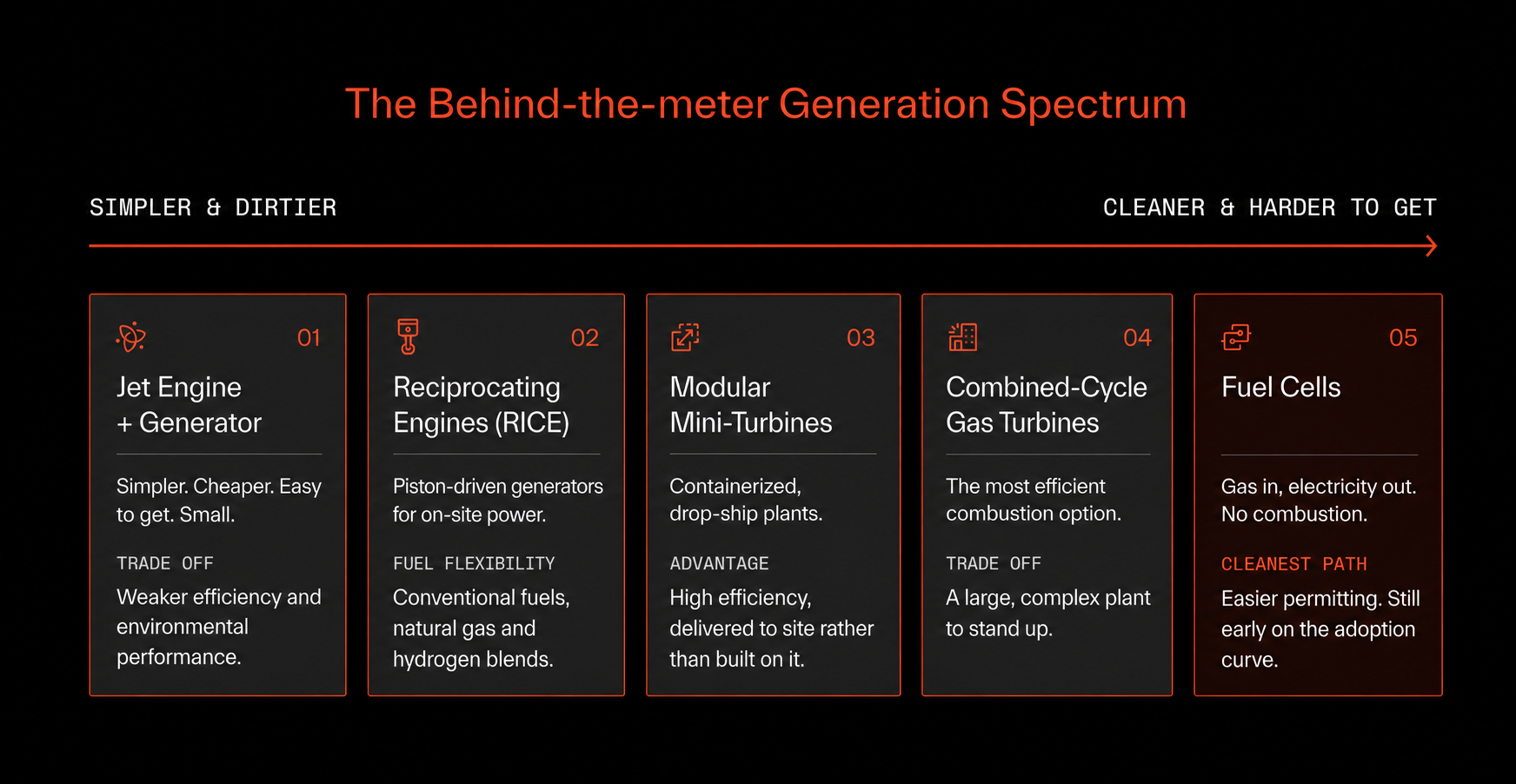
- Jet engine plus generator. A type of open-cycle gas turbine (OCGT) that uses an aviation-derived turbine to drive an electrical generator. It is compact, widely available and relatively quick to deploy, although the trade-off is lower efficiency and less favorable environmental performance.
- Reciprocating Internal Combustion engines (RICE). Reciprocating internal combustion engines use pistons to drive electrical generators and can run on conventional fuels, natural gas and hydrogen blends. Their modularity and fuel flexibility make them a practical option for on-site generation.
- Modular mini-turbines. High-efficiency, containerized, drop-ship power plants that can be delivered to a site rather than constructed on it.
- Combined-cycle gas turbines. The most efficient way to generate electricity from gas, but a major power plant development and correspondingly complex to stand up.
- Fuel cells. These convert gas into electricity through an electrochemical process rather than combustion using methane fuel cells. From an environmental perspective that is highly favorable, because getting a permit for a non-combustion process is a lower-resistance path than getting one for burning fuel. This is the technology behind companies like Bloom Energy.
There is a maturity curve here worth being honest about. Fuel cells are newer, and there are still relatively fewer large data centers running on fuel cells alone. Many are in build, planned, or foreseen, but the roster of big references running solely on fuel cells remains short. The likely accelerant is demand itself: the appetite for AI capacity is so large that operators will embrace the technology faster than they otherwise would outside of an arms race for compute.
Hydropower offers another option where geography permits. In countries such as Norway, abundant and continuous generation can make siting a data center near an existing source a credible behind-the-meter strategy, although the opportunity is highly location-specific and depends on accessing available surplus rather than developing new hydropower assets solely for the facility.
Behind the Meter Is Really About Speed
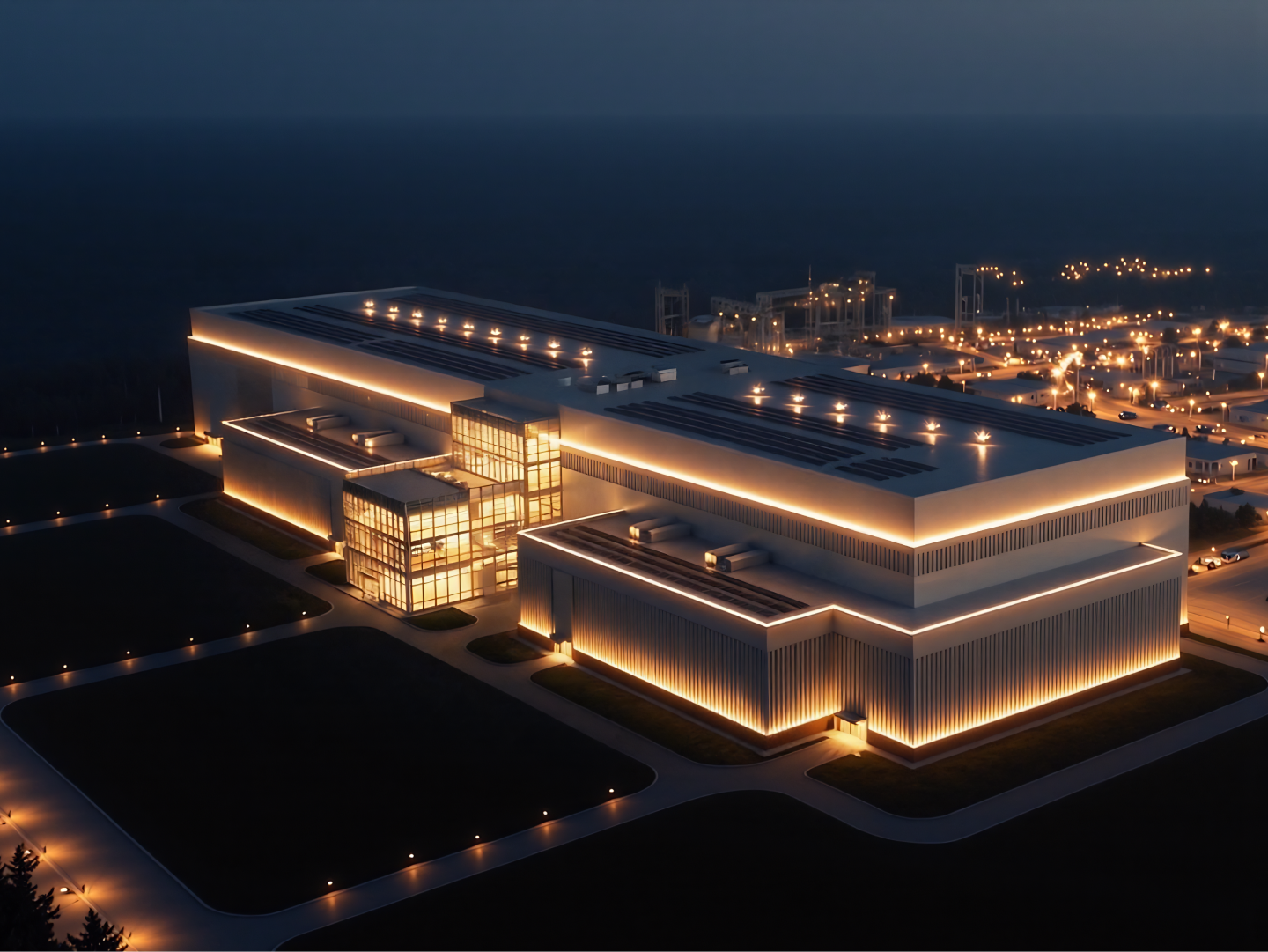
The AI infrastructure market loves headline numbers: seven gigawatts, ten gigawatts, multi-campus regions and mega-sites. But AI capacity today is delivered in practical blocks of 50 MW, 100 MW or 200 MW, making the real question not who can announce the largest site, but who can bring reliable capacity online first.
Behind-the-meter power creates more routes to deployment by reducing dependence on a single electrical utility timeline, incorporating existing energy assets and enabling phased development across brownfield and industrial sites. Crucially, it allows power, cooling, construction and operations to be designed as one integrated system.
Speed is ultimately about sequencing. When the power architecture is defined early, cooling can be aligned with it, modular infrastructure can accelerate construction, standardized equipment can bring forward procurement, and existing energy assets can give development a valuable head start. This is where time-to-market becomes time-to-token.
The Fastest Site Is Rarely a Blank Field
The simplest version of a data center development story is also often the slowest: find land, secure permits, bring in power, build the shell, install the systems, and eventually turn on the racks.
For AI factories, that sequence is under pressure. The power requirement is too large, the market is moving too quickly, and the grid is already stretched in many of the places where AI demand is strongest. That is why the most interesting AI factory sites may not be greenfield parcels. They may be places where the energy logic already exists.
- Former power stations: These sites were built to move large amounts of electricity. Even if the original generation asset is retired, repowered, or used differently, the site may still have grid infrastructure, substations, transformers, access roads, and land that would be difficult to recreate from scratch.
- Heavy industrial sites: Steelworks, glass plants, refineries, and other energy-intensive facilities were often built around power, heat, fuel, or high-capacity grid access. If the original industrial use is declining or being decommissioned, the site may already have part of the energy foundation an AI factory needs.
- Brownfield locations with existing infrastructure: Large industrial parcels can come with established zoning, utility corridors, water infrastructure, transport access, and fewer residential neighbors than a new greenfield development. That does not remove planning risk, but it can change the starting point.
That is the path of least resistance: not a greenfield with a pipeline problem, but a brownfield with the hard infrastructure already there. And reuse is not always like-for-like. An old generating site can be repurposed with new, modern generation technology, subject to emissions and planning. Take a site whose original plant has been disassembled, build something clean and current on it, and you have behind-the-meter power on land that already welcomes it.
The Grid Is Not Always the Grid You Think It Is
When people discuss grid constraints, they usually mean electricity: interconnection queues, transmission reinforcement, substation capacity and utility lead times.
The gas grid offers another route to electrical capacity, particularly at former industrial sites with high-capacity connections already in place. Fuel cells provide another option by converting methane into electricity electrochemically, potentially offering a more favorable environmental and permitting profile. Although adoption in large data centers remains early, AI demand is accelerating their development.
There is no universal answer, so power strategies must begin with the site: what energy assets exist, what can be permitted and built, and what can support AI workloads within a credible timeline?
Power and Cooling Are Now the Same Conversation
Behind-the-meter power only matters if the AI factory can use it efficiently, and modern GPU clusters concentrate so much power within dense racks that cooling is no longer a facilities detail but a core infrastructure decision.
As air cooling reaches its limits, liquid cooling, direct-to-chip systems and advanced thermal designs become essential, linking the cooling model directly to the power architecture, building design and delivery timeline.
Efficiency is also becoming a permission-to-build issue, with regulators and communities scrutinizing power usage effectiveness, water consumption, heat reuse and how effectively energy is converted into useful compute.
A power-first AI factory must therefore be more than a powered shell; it must integrate energy, cooling, density, networking, scheduling, maintenance and operations into one coordinated system. That is the Radiant approach.
From Powered Land to Production AI
“Powered land” has become one of the most valuable phrases in data center development. It is also one of the easiest to misuse.
A site is not valuable simply because someone claims a future power path. It is valuable when the route from energy to production capacity is credible. For an AI factory, that means several things have to line up:
- Power must be real, not theoretical. The site needs a credible path to electricity that can be delivered at the scale and timing customers require.
- Permitting has to be understood early. Planning, environmental approvals, emissions, noise, water, and local engagement can determine whether capacity is actually deliverable.
- Cooling must match the compute density. High-density GPU infrastructure needs thermal design built into the site plan from the beginning, not added later.
- Construction has to support phased delivery. Modular, repeatable infrastructure can help turn capacity on in blocks instead of waiting for a single large buildout.
- Operations must be part of the design. Power becomes useful only when it supports reliable clusters, resilient workloads, and production AI at scale.
Behind-the-meter power brings energy closer to compute,minimises grid transmission and distribution losses, provides greater control over timelines, resilience and site design.
Build Where Power Becomes Capacity
The AI era will not be built on distant promises of future gigawatts. It will be built site by site, phase by phase, by teams that can turn energy into working infrastructure. Behind the meter is not the whole answer. But for faster AI factories, it is one of the most important places to begin. Radiant builds AI factories from the power up, connecting energy strategy, site development, cooling, deployment, and operations into one delivery model.