


An AI cluster’s operating model determines what happens after the hardware is deployed: who maintains it, who responds when something goes wrong, and how technical decisions reflect the customer’s priorities.
AI infrastructure depends on close coordination between compute, networking, storage, and the facilities that supply power and cooling. A problem in one area can affect performance across the cluster. A May 2026 technical report from Lablup recorded 17 failure events over 55 days in a 504-GPU production cluster, spanning interconnect errors, memory errors, unreachable machines, and performance degradation. Keeping these environments running requires continuous monitoring and engineers who can diagnose problems across systems, with clear responsibility for seeing an issue through to resolution.
Those responsibilities vary between deployments. A hyperscale customer with an established software and operations stack may need physical infrastructure support. A team using Radiant’s platform needs support that extends into software, networking, and service reliability. A sovereign deployment introduces additional expectations around where those functions are performed and who performs them.
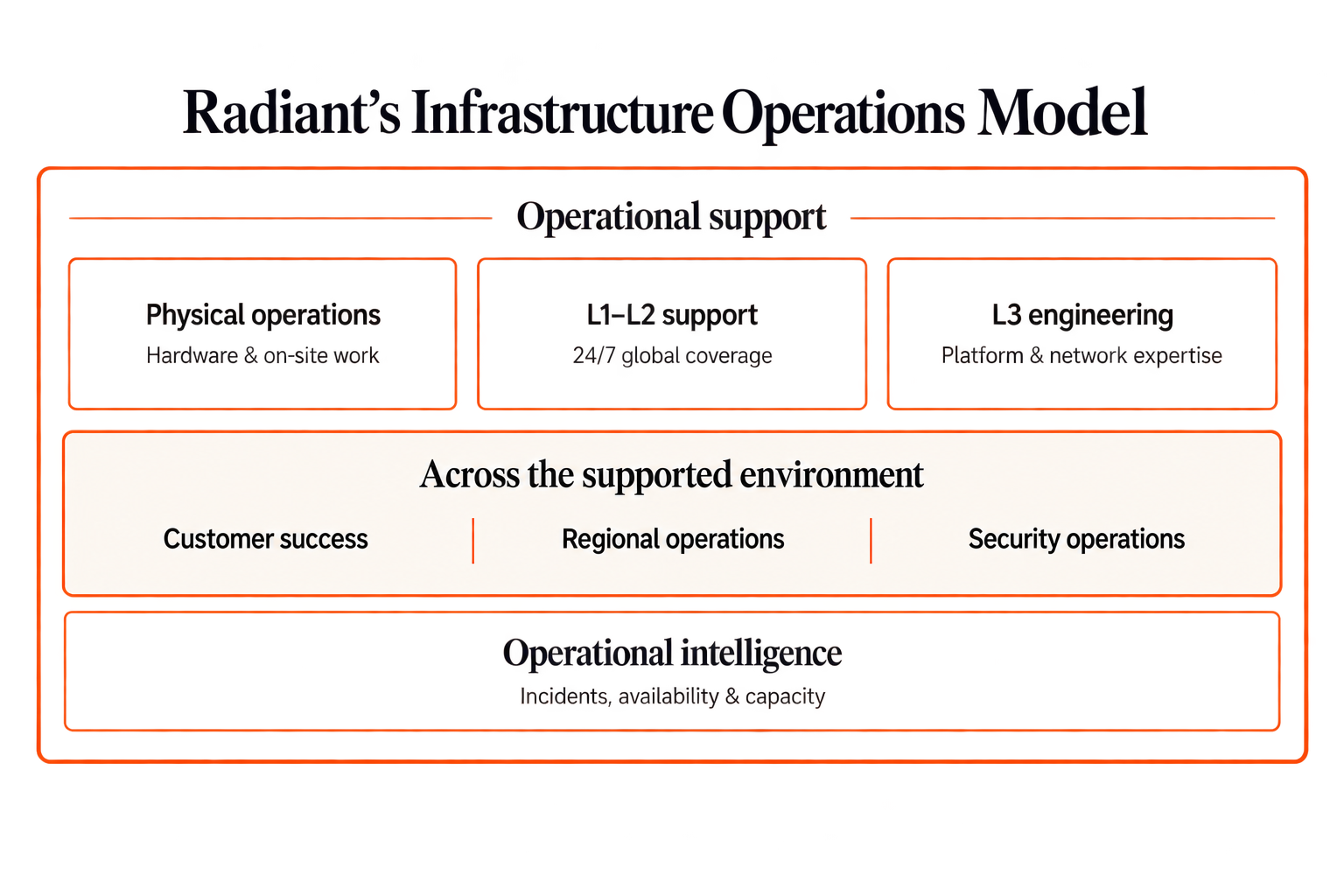
Radiant’s infrastructure operations model is structured around these differences. Physical operations, technical support, customer representation, and regional capabilities work together, with their responsibilities defined by the needs of each deployment.
Defining Operational Responsibility
The first question is what the customer needs Radiant to operate.
For deployments where customers manage their own software stack, Radiant’s responsibilities can center on the physical cluster. This includes replacing failed GPUs and other components, coordinating hardware returns and replacements, managing firmware, networks and carrying out the on-site work needed to maintain the infrastructure.
When Radiant’s platform is part of the deployment, the operating scope expands. Software failures, network behavior, and their effects on service availability require additional expertise and a deeper understanding of the environment.
A hardware replacement and a platform incident may involve the same infrastructure, but each requires different diagnostic skills and a different path to resolution. Defining the scope establishes which teams are responsible and the expertise they need.
A Support Model that Connects Coverage with Expertise
Radiant’s Level 1 and Level 2 support function provides initial technical investigation and ongoing assistance, while owning customer communication, managing expectations, coordinating escalations, and driving incidents toward resolution. As the managed environment becomes more extensive, specialist engineering becomes increasingly important.
Deploying the platform adds software and service dependencies to the GPU cluster, making Level 3 support a critical part of the model.
Radiant’s network engineers and site reliability engineers bring the expertise needed to investigate those more complex issues. Their role extends to understanding the impact of a failure across the supported environment, where the visible symptom may be removed from its underlying cause.
The aim is to connect continuous support with the right depth of technical expertise. Customers need both an accessible support function and a route to the engineers capable of resolving problems within the agreed operating scope.
Continuous Support Through a Follow-the-Sun Model
AI infrastructure runs across time zones, and an incident can remain active beyond any one team’s working day. Radiant’s follow-the-sun model provides 24/7, year-round support through a globally distributed team, maintaining continuity across regional working hours.
That continuity ensures investigations progress regardless of timezone. Logs, metrics, documented findings, and troubleshooting steps give engineers the context to continue the work. Clear ownership keeps the incident moving toward resolution, with specialist engineers brought in where needed.
Give Customer Priorities a Voice Inside Operations
Technical expertise needs customer context. An operational decision can affect a model launch, inference UX, or a critical workload. Understanding that significance requires an ongoing relationship with the team using the infrastructure.
Radiant assigns customer success managers to major accounts to bring that perspective into the organization. They explain customer requirements and bring their priorities into discussions with the teams responsible for delivery and operations.
As a deployment evolves, this relationship helps those teams make decisions with an understanding of the customer’s objectives and commitments.
Regional Requirements Are Built into the Operating Model
Global coverage provides a foundation, but operating in a region introduces requirements that shape how support is delivered. Radiant’s regional capabilities, including in the European Union, address four considerations:
- Language: Support combines global English-language coverage with language capabilities aligned to regional customer needs.
- Local knowledge: Teams understand the operating environment surrounding the infrastructure and the customers it serves.
- Sovereign scope: Support, engineering, compliance, and security functions operate within defined regions where the engagement requires them.
- Site coordination: Regional teams work with the people responsible for physical infrastructure and on-site operations.
Security Operations Shaped by Deployment Requirements
Security requirements govern who can access an environment, where that access originates, and who is authorized to investigate or intervene. Radiant combines a global security operations function with regional and customer-specific arrangements where required.
Security teams work with physical operations, technical support, and regional colleagues to ensure investigations and interventions follow the customer’s access rules, operating procedures, and agreed scope of service.
Service Improvements Informed by Operational Evidence
Operational intelligence connects day-to-day activity with service improvement through structured reporting on incidents, availability, uptime, and capacity.
These measures provide a basis for understanding how the service is performing and where it needs to improve. Considered together, they help teams identify recurring issues, understand capacity constraints, and assess whether operational changes are producing the intended results.
Radiant uses this reporting to support both internal improvement and clearer customer conversations. It gives operational and customer-facing teams a common basis for discussing performance, priorities, and capacity needs.
The goal is to explain service performance through evidence and use that evidence to improve how the organization works.
Bringing People, Processes, and Infrastructure Together
Radiant’s approach starts with the responsibilities of each engagement and aligns the supporting organization around them. Physical operations provide the foundation; technical support and specialist engineering extend with the service; customer success maintains context; regional and security capabilities reflect the deployment’s requirements.
As AI infrastructure grows in scale and complexity, the coordination between these functions becomes increasingly consequential. That is what Radiant’s operating model brings together: clear responsibility, continuous coverage, and the engineering depth to support each deployment throughout its operating life. It gives customers a consistent operational relationship as their workloads, priorities, and requirements evolve.