

Baseten helps AI teams train, deploy, and serve models with the performance and reliability required for production. Their managed post-training product, Baseten Loops, provides supervised fine-tuning and reinforcement learning through a Python SDK. Training, sampling, weight synchronization and checkpointing must work together across a distributed system, often while processing large datasets and long sequences. Baseten therefore needed infrastructure that could sustain these workloads without compromising the simplicity of its product.
Reimagining the path from training to inference
Post-training has traditionally required separate systems for training, sampling, orchestration and inference. At frontier scale, researchers must also determine how models are sharded, memory is managed and work is distributed across nodes.
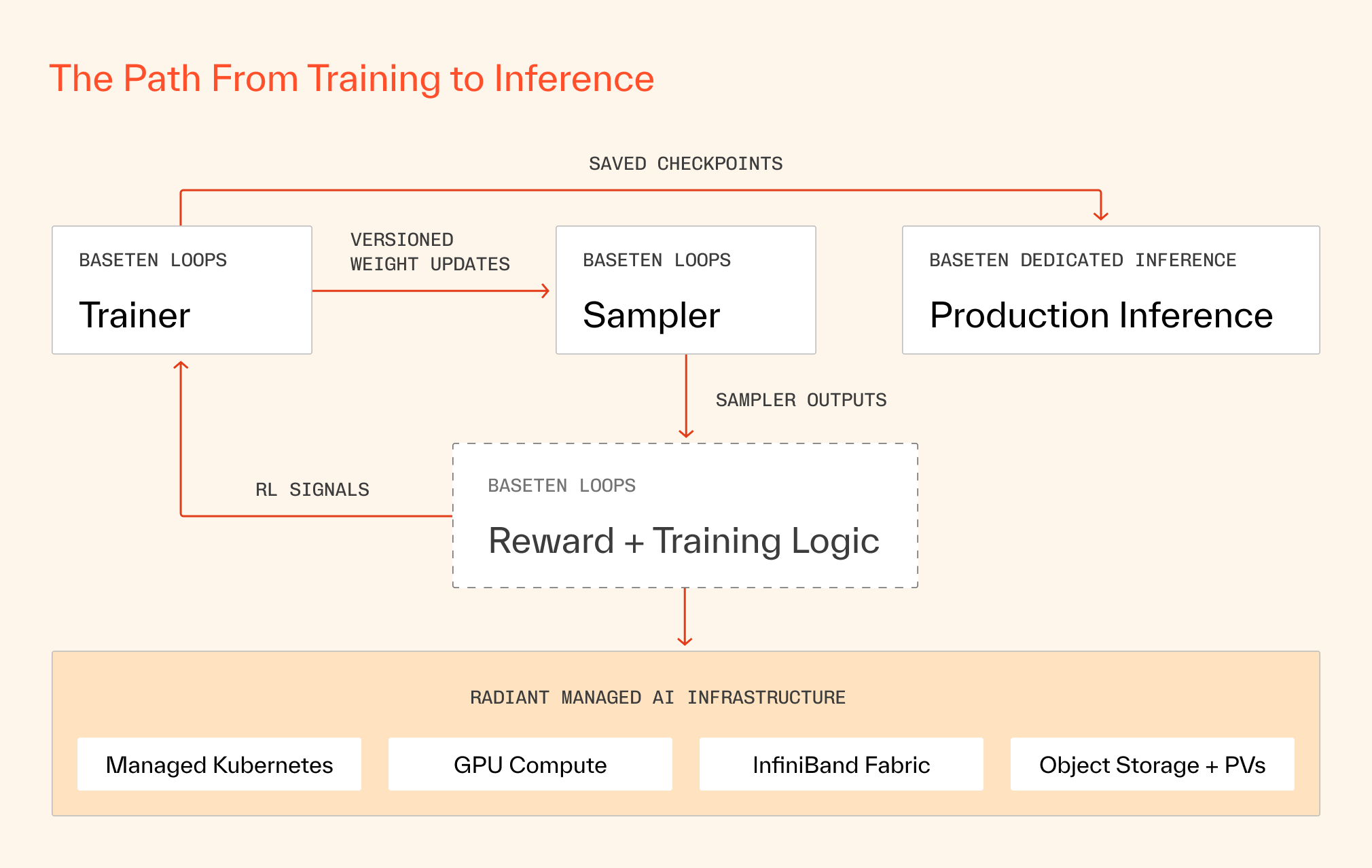
Baseten Loops provides Python primitives for training and sampling. Baseten handles model sharding, memory management, and parallelism. Separate trainers and samplers can scale independently, allowing training and sampling to overlap in asynchronous RL workflows. The platform supports supervised fine-tuning, asynchronous reinforcement learning and sequence lengths up to 262,144 tokens on supported models and configurations.
Baseten designed Loops around every successful run’s destination: production. Researchers can deploy saved checkpoints to Baseten Dedicated Inference with one command, reducing friction between training and serving.
As Baseten simplifies the developer experience, infrastructure demands increase. Loops can overlap training and sampling in asynchronous RL workflows, updated weights move rapidly through the cluster, and checkpoints remain available throughout the workflow. Any bottleneck or failure can reduce GPU productivity, extend run times or interrupt valuable work.
Managed Kubernetes for reliable workflows
Baseten needed a Kubernetes environment that could support fast-evolving training workloads without requiring its engineers to operate the cluster beneath them. It also needed the flexibility to evolve its platform architecture as Loops expanded.
For distributed training, the Kubernetes layer must remain stable as workloads scale and the platform changes around them. That reliability helps protect long-running jobs, maintain GPU utilization and keep development moving.
Radiant Managed Kubernetes provides a production-ready foundation with managed cluster operations, managed upgrades and direct technical support, allowing Baseten’s engineers to remain focused on the product. Radiant manages the Kubernetes lifecycle, capacity and hardware environment while Baseten deploys and evolves its services on top.
Building the data path for distributed training
Radiant supports Loops by providing a scalable compute infrastructure connected via InfiniBand. The high-speed fabric allows multi-node training traffic to move at the rate required by tightly coupled workloads, helping the cluster operate as a coordinated system rather than a collection of individual servers. Baseten operates the Loops training and sampling services and manages the training-to-deployment workflow.
Each server provides plenty of local NVMe capacity, keeping frequently accessed data close to the GPUs during active runs. This reduces unnecessary movement through shared storage and helps maintain performance.
Beyond the servers, a petabyte-scale, parallel storage footprint provides both S3-compatible object access and persistent volumes. One storage subsystem supports datasets, model weights, checkpoints and temporary state. A separate CPU transfer tier handles high-volume ingress and egress, while resilient persistent volumes and external copies protect model state beyond the local NVMe layer.
InfiniBand supports communication between distributed training workers. Loops manages the publication of updated LoRA adapters and their loading into the sampler without a restart.
Turning infrastructure reliability into product performance
“Radiant has given us a reliable foundation for Baseten Loops and responds in real time when we need them, so we can stay focused on the training experience we deliver to customers.” - Raymond Cano, Product Lead
Radiant’s GPU environment provides a dependable foundation for supported models from the Qwen and Kimi families. Baseten can focus on improving training and sampling performance, extending model support, and refining the developer experience, while Radiant manages cluster maintenance, infrastructure updates and hardware issues.
The shared responsibility model allows Baseten to focus on sophisticated post-training workflows while Radiant helps keep the compute, networking, storage and operational layers performing reliably beneath it.
The result is infrastructure performance that reaches the product. Training and sampling can remain in motion, model state can travel predictably through the system, and trained checkpoints have a direct route into Baseten’s production inference platform.
Expanding what AI teams can bring into production
As post-training becomes central to building differentiated AI systems, the distance between experimentation and production needs to become shorter. Baseten is closing that distance by bringing training and inference together on one platform.
Radiant provides the managed foundation that helps Baseten deliver that experience at scale. Together, we’re creating a more predictable path for enterprises to specialize frontier models and deploy them with the performance, reliability and operational confidence required in production.