
When an AI factory sells bare metal, each customer controls the host operating system outright, across thousands of GPUs on a shared fabric. Isolation therefore has to be enforced outside the host, on hardware the tenant cannot reach. More importantly, that isolation must be proven again every time a server changes hands.
NVIDIA Infra Controller (NICo) is part of NVIDIA DSX OS, an open-source, modular software stack for building, operating, and scaling multi-tenant AI factory infrastructure. NICo manages the full lifecycle of a bare-metal GPU fleet: hardware discovery and inventory, firmware validation and updates, power control, provisioning and network isolation. It treats every machine as untrustworthy, verifies each server’s identity and firmware before it enters service, and enforces tenant boundaries on the NVIDIA BlueField™ DPU in every server.
Radiant already enforces isolation in the network, with dedicated VRFs and VLANs, access control lists, firewalling and out-of-band management. NICo and BlueField-3 extend that enforcement to each server and automate verification and hand-over across the fleet.
How NICo uses a DPU in every server
Every GPU server in a Radiant AI Factory contains an NVIDIA BlueField™-3 DPU, an infrastructure processor with dedicated Arm CPU cores, operating system and management controller. It accelerates networking, storage and security services in a hardware-isolated, host-independent domain. The customer receives the server and its GPUs. The DPU, however, stays under Radiant’s control through NICo and joins the fabric as a network device in its own right, so the tenant’s boundary sits in hardware the host operating system cannot reach.
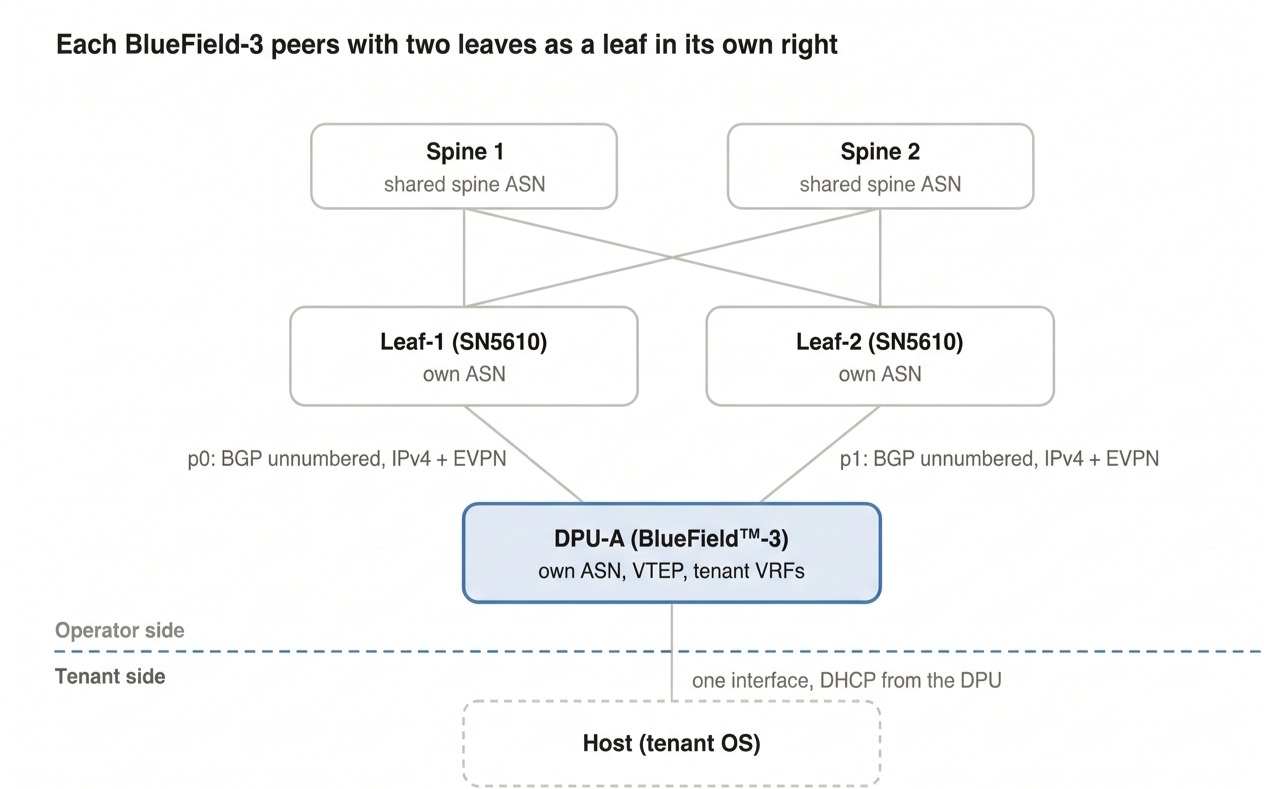
Each DPU connects to two leaf switches, and BGP establishes routes while ECMP distributes traffic across equal-cost paths through the fabric. When a link or a leaf fails, traffic moves to the surviving paths with no action from the tenant.

Where NICo sits in Radiant’s platform
Radiant builds end to end AI factories, from financing to long-term operation for offtake. That capacity is delivered as bare metal, virtual machines, managed Kubernetes and Slurm clusters, with storage and networking. NICo and BlueField™-3 add hardware-enforced isolation beneath all three, so a customer gets the same per-server verification whichever service they choose.
A customer running a managed Kubernetes cluster gets the same server verification and per-tenant network isolation as a customer renting bare metal, because both sit on the same foundation.
Radiant FlightDeck and NICo, working together
FlightDeck runs operations and observability for every Radiant service. NICo adds hardware-enforced lifecycle management at the bare-metal layer: it provisions, verifies, isolates, wipes and re-provisions servers across thousands of nodes. Together they give Radiant a single operational view of every service and per-server isolation enforced in hardware.

Two separate paths. The infrastructure path runs from FlightDeck through NICo and the out-of-band management network to each server’s DPU, and does not depend on the tenant-controlled host operating system. The service path delivers managed Kubernetes, ML services, health and observability to the hosts inside each tenant’s own VRF, so it never crosses tenant boundaries. Bare-metal tenants own the host outright and can run without the service path.
In this design tenancy follows the server, not the rack.
Four layers of assurance
Every Radiant service, from a single bare-metal node to a managed Kubernetes cluster to an ML endpoint, inherits four layers of assurance from the infrastructure beneath it.
Verified identity
Radiant checks each server and its firmware before any customer is allowed onto it.
Private network per tenant
The DPU forwards traffic only within that tenant’s own network, so other tenants’ networks are unreachable from it.
Enforced at every node
Radiant’s isolation has always sat outside the customer’s operating system. The DPU now enforces it on each server individually, so a compromised host stays contained.
Clean hand-over
When a tenant leaves, Radiant wipes the server and reprograms the DPU before the next tenant or service is deployed.
“NVIDIA Infra Controller (NICo) lets us extend tenant isolation to every server and automate bare-metal activation and hand-over, so capacity moves to the next customer faster. It’s a foundational piece of our platform: whether a customer runs on bare metal, Kubernetes or our ML services, they get the same verified, isolated infrastructure underneath.” - JOAO COELHO, CHIEF PRODUCT OFFFICER, RADIANT
“As AI factories scale to thousands of multi-tenant GPUs, automating hardware-level verification, provisioning, and isolation is critical to eliminating idle server time and accelerating time to revenue. NVIDIA Infra Controller (NICo) and BlueField™-3 DPUs empower partners like Radiant to deliver secure, enterprise-grade multi-tenancy while maximizing operational efficiency and fleet availability.” - CHRIS CHO, SENIOR MANAGER OF PRODUCT, NVIDIA
The definition of better together
Every hour a GPU server spends between customers is lost capacity. Across a fleet of thousands of GPUs that time compounds - with material impacts to the economic model for operator and offtaker. Together, NICo and Radiant optimize for both availability and security. NICo runs the wipe, re-verification and reprovisioning as a single gated sequence on the hardware. FlightDeck tracks each server through that sequence alongside the rest of Radiant’s operations, so a released server returns to the pool as soon as the hardware confirms it is ready, and goes to whichever tenant needs it next.
Every step leaves a record. Each DPU configuration change carries a version number the DPU itself confirms, and FlightDeck keeps that history. A customer or auditor can see which tenant network a server belonged to and when, confirmed by the device that enforced it.
NVIDIA DSX OS is built to operate AI factory-scale infrastructure.NICo sits in its infrastructure layer for provisioning and multi-tenant operations, alongside the NVIDIA DOCA software framework for building and accelerating services on BlueField™. An operator can adopt the DSX OS components it needs and run them beside its own platform. Radiant runs NICo alongside FlightDeck.