

A cluster’s installed GPU capacity does not tell you what it can put to work next. Some resources may be reserved, others awaiting maintenance, and others distributed across infrastructure that makes them unsuitable for the job. Understanding those distinctions is a daily operational challenge, and one that becomes more consequential as fleets grow.
For cluster administrators, capacity decisions require a clear picture of availability, ownership, topology, and health. For users, those decisions determine whether a training run can begin as planned or whether an inference deployment has the infrastructure it needs to scale.
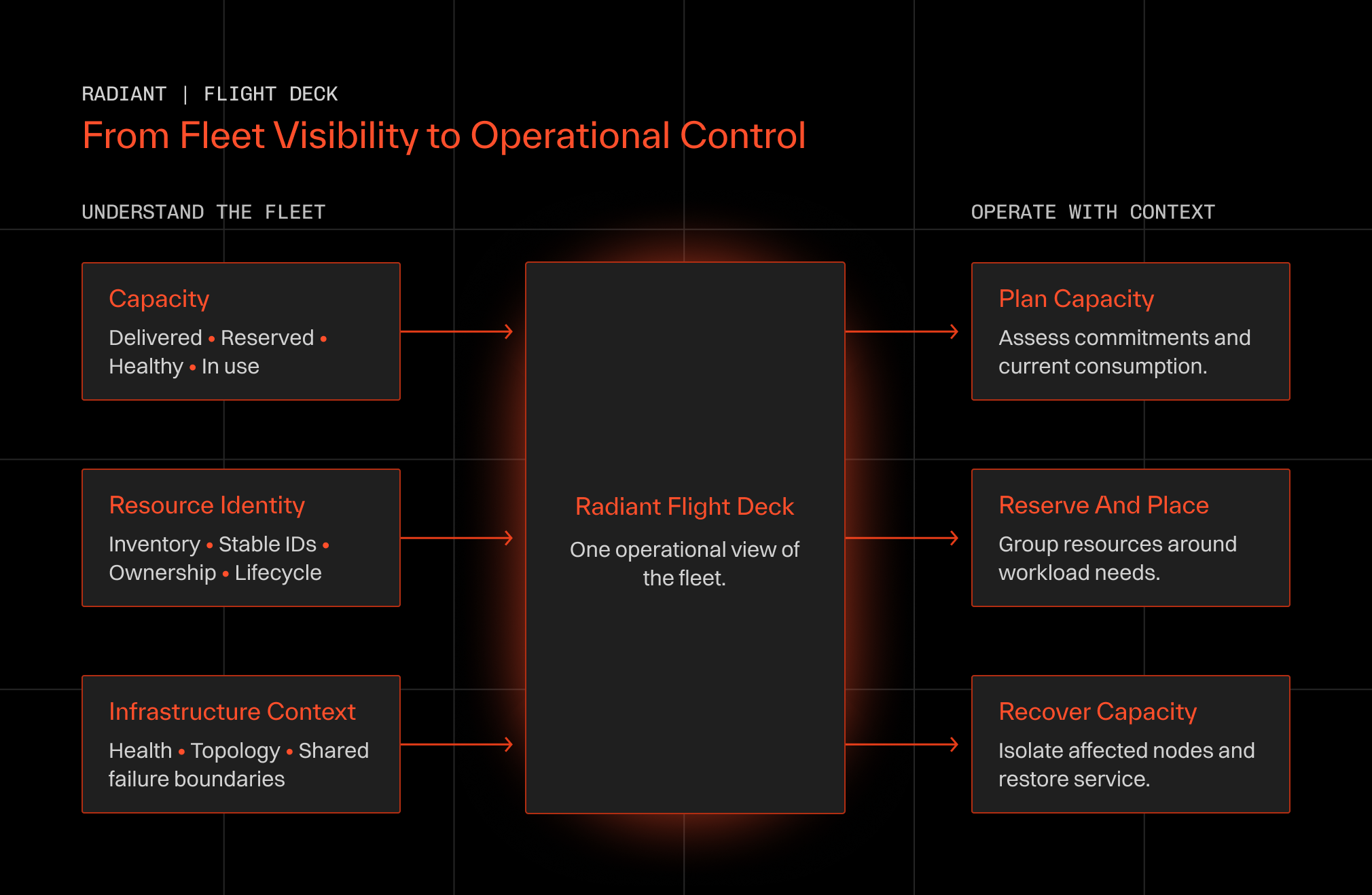
Radiant FlightDeck brings these perspectives together, connecting fleet visibility with the controls administrators use to allocate resources and manage their lifecycle. Its value lies in making the relationship between installed capacity and productive compute easier to understand and act on.
Know What Your Cluster Capacity Can Deliver
Capacity figures can conceal as much as they reveal. A reservation records a commitment, but says little on its own about whether the underlying resources have been delivered, are healthy, or are supporting a workload.
FlightDeck surfaces these complementary views, giving administrators a clearer basis for planning:
These views overlap. A GPU can be delivered, reserved, healthy, and in use simultaneously; each measure answers a different operational question.
The useful information often sits in the gaps between them. Reserved capacity that remains idle warrants a different investigation from delivered capacity undergoing repair. Distinguishing the two helps administrators understand what is preventing resources from becoming productive before making further commitments.
Make Every Resource Discoverable and Accountable
Those fleet-level figures become actionable when administrators can trace them to individual resources.
FlightDeck’s discovery APIs, stable identifiers, inventories, tags, and lifecycle metadata provide a consistent way to identify infrastructure through operational changes. Its shared data model connects resource state with tenant identity, policy, and audit information.
The importance of that continuity becomes apparent during phased deployments. As new hardware enters service, teams must establish what has arrived, who it belongs to, and how it fits into existing operations. Each expansion adds another opportunity for inventory records and operational reality to drift apart.
Programmatic discovery gives administrators a repeatable foundation for reconciling those changes. For users awaiting capacity, it also supports more precise answers: a deployment question can be tied to identifiable resources and their current condition, making it easier to establish what is ready and what still needs attention.
Place Workloads with the Whole Cluster in View
Knowing which resources exist is the starting point for allocation. Deciding which belong together requires a view of the infrastructure connecting them.
FlightDeck supports topology-aware reservations and visibility into network fabrics, storage placement, and failure boundaries.
This context helps administrators assess the suitability of an allocation for a particular workload. Resources that appear interchangeable in an inventory may occupy different positions in the cluster, with different shared dependencies. Placement decisions need to account for those relationships.
They also influence what remains available. An allocation that satisfies today’s request can leave capacity fragmented for the next one, making it harder to assemble a suitable resource group even when the aggregate GPU count appears sufficient. Understanding the shape of an allocation helps administrators weigh immediate demand against the work still to come.
Turn Health Signals into Targeted Recovery
Once a workload is running, the operational challenge shifts to maintaining the conditions that made its allocation suitable.
FlightDeck connects health monitoring and diagnostics with controls to cordon, reset, replace, and restore affected nodes. Its shared model links a fault to the workload and tenant it affects, retaining the context needed to investigate and respond.
That context matters because a symptom does not necessarily reveal the scope of a problem. Several affected nodes may share an infrastructure dependency, while an isolated component issue may justify a much narrower intervention. Treating either case without understanding those relationships can complicate recovery.
Bringing health, topology, and lifecycle information together helps administrators assess where action is needed and which workloads may be affected. It also keeps recovery connected to the wider capacity picture: taking resources out of service changes what the cluster can support, just as restoring them changes what can be scheduled next.

The Benefits: Clearer Decisions, More Dependable Capacity
For administrators and users, these capabilities address several recurring sources of operational uncertainty:
- Better capacity planning. Administrators can distinguish commitments, readiness, and consumption, while users gain a clearer basis for scheduling upcoming work.
- Less coordination overhead. Discoverable resources and consistent identities help teams investigate questions without repeatedly reconstructing the underlying inventory.
- More informed allocation. Topology and failure boundaries give administrators the context to match available resources to workload needs.
- More focused recovery. Connecting infrastructure condition with workload impact helps teams assess where intervention is needed and who may be affected.
The economic significance extends beyond keeping GPUs occupied. Unused capacity can reflect several different constraints, each calling for a different response. Clearer fleet information helps teams identify the cause and direct operational effort toward making that capacity useful.
For users, the practical benefit is greater confidence in the resources supporting their work and better-informed communication when conditions change.
Radiant FlightDeck Makes Fleet-Wide Visibility Actionable
Radiant builds and operates AI infrastructure across data centers, GPU hardware, compute, and managed services. FlightDeck connects these layers so administrators can see what capacity exists, who it belongs to, where it fits, and whether it is healthy, then use that context to allocate resources and manage recovery.
That connection becomes more valuable as deployments grow. A new reservation changes the capacity available for other workloads; a hardware fault changes what can safely remain in service. FlightDeck brings these decisions into a shared operational picture, helping administrators respond with a clearer understanding of the consequences for users.
For businesses deploying hyperscale AI, the benefit is greater confidence in how capacity is assigned, maintained, and returned to service throughout the life of the cluster.