
Standardization is the foundation on which capital formation rests. Having a common specification allows buyers to compare offers, lets lenders to underwrite assets and enables operators to build to a validated design.
Standardization is also what NVIDIA is championing in the realm of AI compute and infrastructure. CUDA is their standard in the software space. The DSX AI Factory architecture is a standard in the infrastructure space. MGX is the standard for building compatible servers across hardware generations.
Standardization is what makes NVIDIA AI factories fungible. Jensen has written extensively on the subject in recent months. His core thesis is that a factory can serve many customers and workloads and, more importantly for an AI compute market, can pass to another customer, cloud or operator when needs change.
I wanted to share some thoughts on what that means, as well as a vision for how this market might evolve over the coming quarters.
The Concept of Compute as Revenue
Back in August, Jensen declared that, “In AI, compute is revenue.” This was part of a larger piece that discussed the consortium of capital allocators that NVIDIA had brought together to establish independent financing platforms to support the buildout of AI infrastructure over time. This group included our parent, Brookfield.
In this essay Jensen talks about how the piecemeal approach of cobbling together financing, powered land, chips and combining them into an AI data center is giving way to viewing the end product as a distinct asset that can be financed through long-duration institutional capital.
The commitment level for this new revolution is staggering. The group that Jensen brought together was committed to mobilizing $500 billion. The total buildout is well into the trillions.
There isn’t a mechanism today to support that level of capital formation or allocation. We need a new one with defined units, measured performance and price discovery.
The Five Layer Cake as a Market Map
Preceding GTC San Jose, Jensen introduced the concept of the five layer cake. We mapped that onto the Radiant value proposition at the time and it is still worthy of your time.

At its core, the NVIDIA model argues that AI is the result of a layered production pipeline in which electricity is transformed into intelligence through successive stages of hardware, infrastructure, and software. The five layers identified by NVIDIA: energy, chips, infrastructure, models, and applications, together represent the full lifecycle of how intelligence is created, deployed, and ultimately consumed.
The point is that the manifestation of AI is not a chatbot or a single model, but is a collection of things that allow that magic to happen. Yes, the output is what is measured in value (and specifically in his world output per watt), but it is the collection of layers that need to be value better - as an integrated unit. This will need to account for the fact that each layer of the cake has a different economic life, risk profile and natural investor.
Making the AI Factory Investable
Going back to the August Jensen post, he identifies four core characteristics of the investable factory:
1. It produces revenue
2. It serves a broad market
3. It improves in performance over time
4. It can be redeployed
While the first two are self-evident, the second two deserve a little more explanation. Let’s start with “it improves in performance over time.”
AI Infrastructure is often thought of as “hard” things, metal, silicon, aluminum, concrete - but software is a core part of the story and software is what enable consistent improvement over time. We have seen this across GPU generations and will continue to see it going forward. What is deployed is not “static” it is simply a starting point. To be fair, that improvement is somewhat difficult to model, but given that amount of data on the subject, reasonable assumptions can be made.
Next is “it can be redeployed.” The analogy is that of airplane leasing. An airplane at the end of its lease can be repainted and released or sold to another airline, shipper, etc. The point Jensen is making is that a datacenter can change hands too, both in terms of the operator, the customer and the workload. Yes, datacenters may be tuned to inference over training or vice versa, but that is no different than a 777 vs a 737 from Boeing.
We know this point to be true. NVIDIA refers to it as fungibility. That term isn’t in the day to day lexicon and has a somewhat specific use but the core concept is that one unit can perform the function of another.
The more fungible something is the more it can be traded easily, which in turn means more liquidity, cheaper financing and tighter pricing.
Real estate is actually legally non-fungible because every parcel is unique. What NVIDIA and the financing community are trying to achieve is to make an AI Factory more fungible so it can be underwritten like a commodity or a bond. This in turn makes it easier to finance, which as we know from earlier is important given the scale we are talking about.
The following adds fungibility:
- The MW as unit of account. Wholesale capacity is priced per kW per month. That gives a common denominator across sites.
- Hyperscaler-spec design. A shell built to a standard hyperscaler spec can be re-let to another hyperscaler. That is the residual-value argument lenders care about. That is why the NVIDIA DSX Blueprint is the standard and the resultant performance achievements result in another standard: NVIDIA Exemplar status. These aren’t participation awards, they have material financial implications.
- Securitization. Since 2018, investors have bought rated bonds backed by data center leases. Rating agencies reward homogeneity: nearly all of these bonds are backed by wholesale hyperscale facilities and Moody's assigns higher ratings to newer facilities in primary markets with long leases but that is changing in the AI Factory world (Memphis, TN and Richland Parish, LA). Pooling works when assets can be modeled as a class. The existing framework covers the building. The compute inside it, where most of the capital sits, has no equivalent yet. This is why NVIDIA's standards are important. Through them they are building the conditions for securitization.
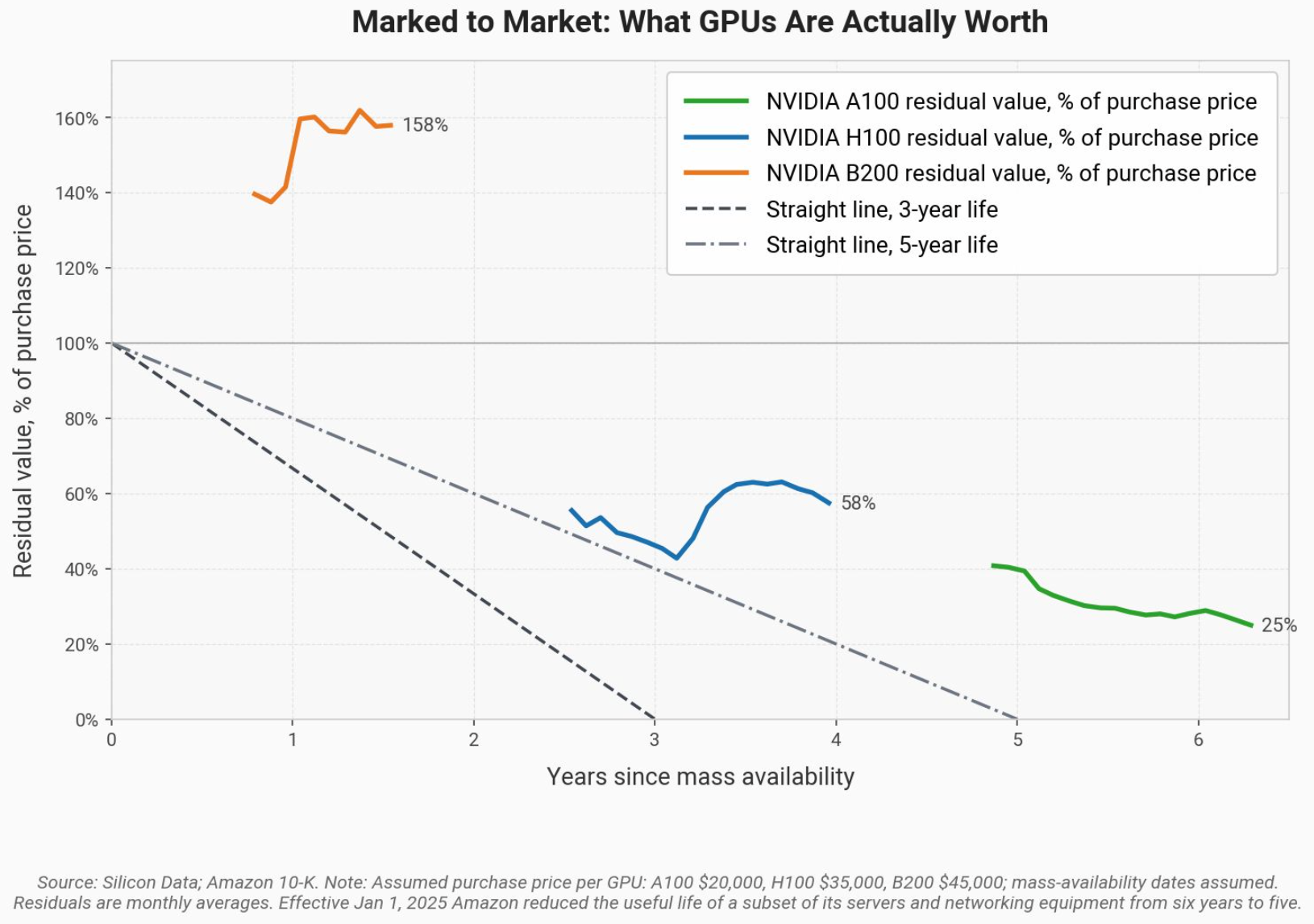
- Compute indices. Rental price indices for GPUs such as H100s are will turn GPU-hours into a quoted commodity with a curve.
What negatively impacts fungibility:
- Location. Latency, grid position, water, and jurisdiction. Training is latency-tolerant, so it chases power and is more location-fungible. Inference is latency-sensitive and less so.
- Power density and cooling. Legacy enterprise racks run around 10 kW. Current AI racks run 100 kW+ on liquid cooling. An AI-optimized hall is a poor fit for enterprise colo, and a legacy hall is often unusable for frontier AI. The asset base is splitting into two classes that do not substitute for each other.
- Time. A MW energized in 2026 and a MW energized in 2029 are different products. Delivery date is a pricing variable, and in AI it is often the dominant one.
- Tech cycle against asset life. NVIDIA’s roadmap has GPU generations turning over every 12 months. Buildings are underwritten over 15 to 20+ years. Design choices made for one chip generation can strand capacity for the next. See Manesh Patel’s post on this.
- The compute layer. A GPU-hour is less fungible than the indices imply. Cluster size, interconnect (InfiniBand or Ethernet), reliability, the software stack and data residency all separate one H100-hour from another. A 16-GPU node and a 16,000-GPU contiguous cluster are different products.
- Collateral. GPU-backed debt depends on how redeployable the chips are. GPUs can be moved and resold, which helps. They also depreciate and the resale market is thin at scale and is mostly untested.
In practice, fungibility in datacenters comes down to one question: if this tenant leaves, who else takes the capacity, at what price, how fast, and at what retrofit cost?
The answers to those questions determine the cap rate, the advance rate, and whether the asset can be securitized.
Why DSX (and other standards) Matter
NVIDIA has invested massively in the DSX standard. It includes a wide range of elements including the Reference Design, DSX Sim, MaxLPS, Flex, Exchange and DSX OS, co-designed across chips, systems, networking, software, power, cooling and operations.
Each are linked, and it is beyond the scope of this post to detail each one. What they collectively achieve, however, is worth some time. Collectively, they drive standardization.
Standardization is what securitization runs on. A lender securitizing a pool of assets needs three things. It needs to know what the asset is. It needs to trust the asset's quality before capital goes in. It needs to measure performance once the asset is running. Until very recently, AI factories have not offered any of these on a repeatable basis. Each site has been a custom build, underwritten on its own terms and financed as a one-off project.
Factories built to the DSX design, with certified components, validated before construction and reporting the same operating data, become the investable asset class. They can be pooled, rated and sold to investors who will never walk a row of servers.
It is not just creating liquidity, it also reducing the cost of capital. Diligence gets cheaper because the lender can rely on the standard. Risk falls because performance is validated in advance and measured continuously. Debt sizing gets more precise because the link between power in and output out is known.
The benefit compounds over time with each new factory adding to the pool and tightening the variance standard.
The historical antecedents are everywhere - grain, oil, cell towers, mortgages. When they were standardized the capital markets quickly followed.
DSX does this work for AI factories. It gives financiers a standard unit and a measurement system. That is the precondition for moving AI infrastructure out of bespoke project finance and into the capital markets, where capital is cheaper and far deeper.
Where This is Going
On the sovereign side we talk about rhetoric -> policy -> execution. As we look at creating a market for AI compute, we are entering the execution stage. The Chicago Mercantile Exchange (CME) and Silicon Data plan to list H100 and B200 compute futures in October, but pending regulatory review has pushed that until at least November. This will represent the first public forward curve and buyers will be able to lock in costs and operators can hedge compute rental-price exposure.
There is an active market for a variety of debt instruments today.
While buildings are covered today, compute is on the horizon and the SEC is looking at GPU and bare-metal securitizations. With the recent launch of DSX certification for power and cooling products, there will soon be more coverage for the DSX factory design. As we noted, more standardization equals more securitization.
As these markets develop we will see more operating data. That is a function of the fact that lenders underwriting residual value will prefer real numbers to index assumptions. Operators that can supply them will get financed on better terms (see FlightDeck).
This market starts with H100 and B200 but it will grow quickly to cover more chips. Given the work that NVIDIA has done around DSX, they will have a material headstart over a market for other accelerators.
It is an exciting time to be building and an exciting time to have the capability set that we do at Radiant. With Brookfield’s backing and financial sophistication and our software and compute expertise the opportunities are exceptional.