.png)
The moment compute goes live is when the real operational work on AI infrastructure begins. Every server, switch, network connection, and storage node enters a continuous lifecycle of provisioning, configuration, maintenance, diagnostics, security updates, and recovery. AI factories succeed not just because infrastructure is deployed, but also because it is managed continuously. Radiant embeds compute and networking lifecycle management into the operating model of the AI factory, bringing these processes together within a consistent, programmable system.
How Radiant Manages the Infrastructure Lifecycle
The Radiant platform manages the activities that follow across compute, networking, storage, and management infrastructure, including:
- Creating, updating, and retiring compute resources
- Configuring networking and hardware topology
- Discovering infrastructure inventory automatically
- Applying security policies and service identities
- Coordinating maintenance and firmware updates
- Recovering systems following operational issues
- Validating and returning capacity to production
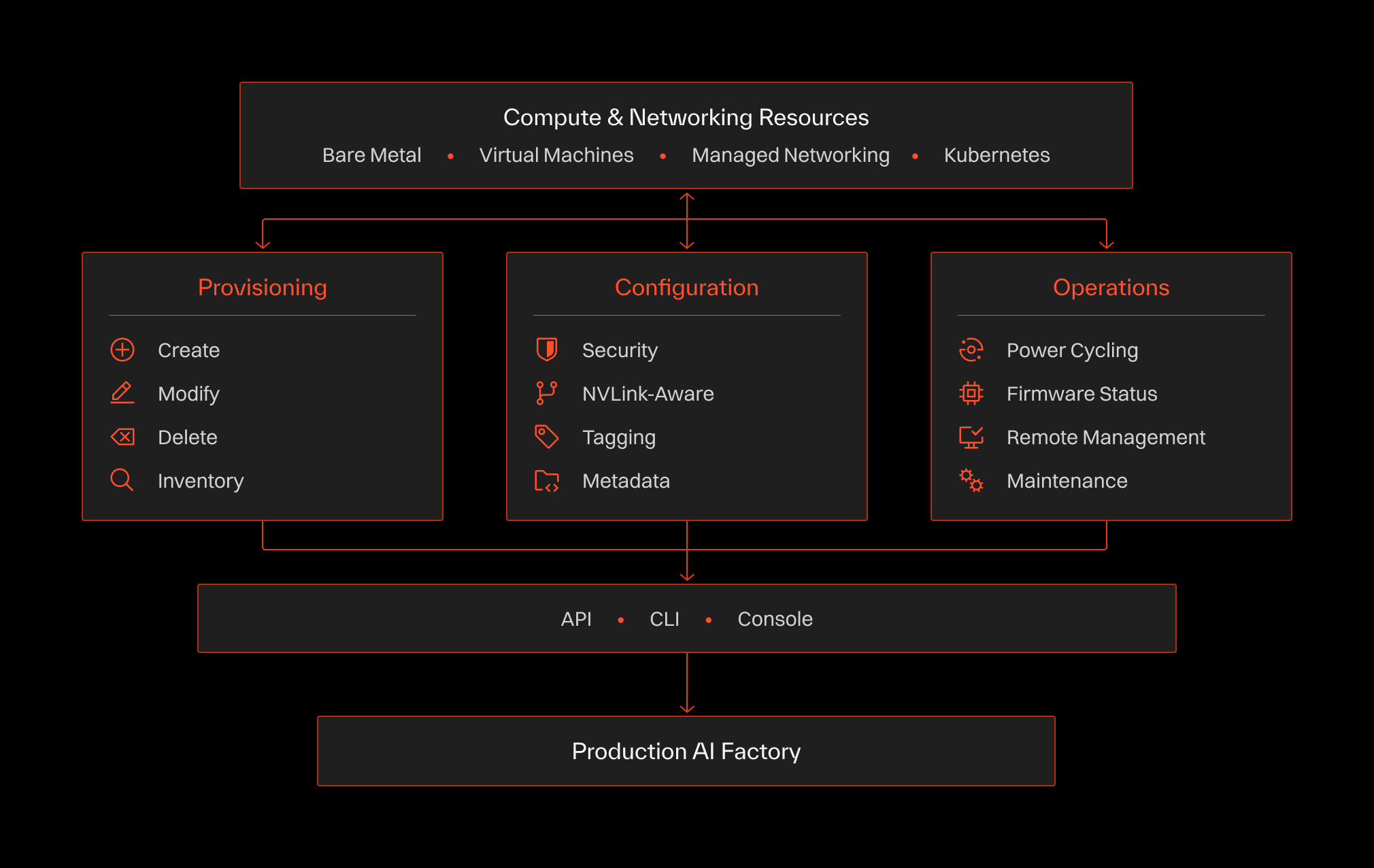
These activities take place continuously across thousands of servers, switches, storage systems, and management controllers. Radiant orchestrates them as part of a unified operational lifecycle rather than as disconnected manual processes.
Turn Resource State into Operational Action
Operators cannot automate what they cannot observe. Radiant maintains explicit lifecycle states for every managed compute and networking resource, providing continuous visibility into where each asset sits within the operational pipeline. Resources transition through well-defined states, including provisioning, running, degraded, maintenance, stopping, stopped, terminating, and terminated.
Radiant Flight Deck uses this live state information to make placement, maintenance, and capacity decisions without relying on manual inspection. The result is a consistent operating model for managing infrastructure health, availability, and return to service across the AI factory.
Radiant APIs and CLI for Infrastructure Operations
Radiant exposes the complete compute and networking lifecycle through comprehensive APIs, a command-line interface, and a unified management console. Operators can provision, modify, and retire compute resources, configure networking, discover hardware inventory and topology, perform power operations, coordinate maintenance workflows, manage firmware, and integrate storage lifecycle operations through a consistent operational interface.
The platform also centralizes user, group, role, and service account management, allowing security and governance policies to be applied alongside infrastructure operations. Together, the APIs, CLI, and a management console integrate directly with deployment pipelines and automation frameworks, creating a consistent operating model for AI factories at scale.
Preserve Performance with Topology-Aware Operations
Systems such as NVIDIA NVL72 rely on high-bandwidth NVLink domains and tightly coupled network architectures. Workload performance therefore depends not only on how many GPUs are available, but also on how those GPUs are connected.
Radiant incorporates topology awareness directly into provisioning and scheduling workflows. GPU domains, accelerator connectivity, and network topology are represented within the resource model, enabling workloads to be placed on infrastructure that preserves high-performance communication between accelerators.
This supports more predictable application performance and more efficient use of large GPU clusters.
Using Metadata for Operational Control
As AI factories expand across customers, projects, and workload environments, infrastructure metadata provides the context required to manage them consistently.
Radiant associates managed resources with operational metadata such as:
- User-defined labels and tags
- Cloud-init configuration
- Tenant and workload attribution
- Resource ownership
- Automation and governance policies
This metadata follows resources throughout their lifecycle and supports provisioning, scheduling, governance, chargeback, and operational reporting. Infrastructure teams retain a consistent view of what each resource is, who it belongs to, how it is configured, and how it can be used.
Keep Infrastructure Visible Through Failure
Some infrastructure issues occur before the operating system becomes accessible. In these cases, conventional monitoring and remote access channels may no longer be available.
Radiant provides integrated serial console access and persistent console logging throughout the lifecycle of managed systems. Operators can investigate boot failures, firmware issues, and low-level platform faults even when the host operating system is unavailable.
Console telemetry, diagnostics, and recovery workflows are surfaced directly through Radiant Flight Deck, helping operators identify, isolate, and resolve infrastructure issues faster while maintaining complete operational visibility.
Assigning Stable Resource Identifiers
Reliable automation depends on consistent infrastructure identity.
Radiant assigns persistent identifiers to managed compute and networking resources throughout their operational lifecycle. A resource retains its identity through maintenance, temporary outages, configuration changes, and return-to-service workflows.
These stable identifiers support asset tracking, monitoring, configuration management, incident response, lifecycle history, and capacity planning. Automation remains tied to the correct physical or logical resource even as its operational state changes.
Protect the Hardware Root of Trust
Infrastructure trust begins below the operating system. Radiant incorporates firmware lifecycle management into the broader operational workflow. Firmware can be returned to a verified known-good state between tenant allocations, while signed images and platform attestation help confirm the integrity of the system during startup.
This extends lifecycle governance into the hardware foundation of the AI factory. Firmware state becomes part of the same operational model used to manage software, access, maintenance, and infrastructure readiness.
Radiant Delivers Standards-Based Remote Management
Large GPU fleets require secure and programmable infrastructure management. Radiant uses standards-based interfaces such as Redfish over TLS to support monitoring, maintenance, firmware operations, hardware control, and remote lifecycle management.
These capabilities are surfaced through the Radiant platform, providing operators with a unified operational interface for monitoring infrastructure health, executing remote lifecycle operations, coordinating maintenance, and managing compute and networking resources at AI factory scale.
Operate Infrastructure Confidently with Radiant
Deploying thousands of GPUs is only the beginning. The longer-term challenge is keeping compute and networking infrastructure healthy, secure, and productive throughout years of continuous operation. Radiant embeds lifecycle management throughout the AI factory, from provisioning and topology management to maintenance, diagnostics, firmware governance, and return to service. By bringing these processes into one operational system, Radiant enables infrastructure to remain reliable, trusted, and production-ready throughout its working life.