

Tokenomics is the economics of AI inference: how GPU infrastructure cost turns into the cost, volume and business value of tokens delivered as AI output. Some of the earliest work on tokenomics came from SemiAnalysis, which examined how hardware, software and workloads shape the economics of AI output. That relationship has become far more consequential as reasoning models and AI agents change both the scale and shape of inference.
The first wave of generative AI centered largely on direct prompt-and-response interactions, while agentic systems turn a single request into a sequence of reasoning, retrieval, tool use, verification and repeated model calls. Reasoning, or “thinking,” models use test-time scaling to allocate additional compute after a prompt arrives, allowing them to explore different approaches, check conclusions and refine the final answer.
Agentic AI multiplies this pattern across an entire workflow. One instruction can trigger dozens of model calls as an agent searches, retrieves documents, invokes tools, corrects errors and verifies its output. Tool responses expand the context, while parallel agents can explore several possible paths. For example, Anthropic’s multi-agent systems consume about 15x more tokens than chats.
The final answer captures only a fraction of the intelligence produced behind it. More tokens enable richer reasoning and more capable agents, but inference costs can keep rising even as token prices fall because each task is becoming more ambitious and computationally intensive.
For AI infrastructure buyers, businesses deploying hyperscale AI and technology decision makers, that shift makes cost per token and system efficiency the metrics that increasingly determine whether AI deployment scales profitably. NVIDIA GB300 is already rewriting that equation.
GB300 Addresses the Bottlenecks of Modern Inference
GB300 NVL72 is a liquid-cooled, rack-scale system in which 72 Blackwell Ultra GPUs and 36 Grace CPUs operate across a 72-GPU NVLink domain, with 130 TB/s of aggregate NVLink bandwidth, 20 TB of high-bandwidth GPU memory and 37 TB of combined fast memory.
Each Blackwell Ultra GPU carries 288 GB of HBM3e, 50% more than standard Blackwell, while adding 50% more dense NVFP4 compute and more than doubling attention acceleration compared with Blackwell.
Those specifications map closely to modern inference: prefill is compute-intensive, sequential decode is sensitive to memory bandwidth and latency, long contexts pressure the key-value cache, and mixture-of-experts models generate extensive all-to-all traffic.
GB300 addresses these constraints as a complete system. Additional HBM holds larger models, batches and KV caches closer to compute, while NVLink allows the rack to operate as one high-bandwidth scale-up domain.
The result is not simply greater performance, but more delivered intelligence from every GPU hour and megawatt. This shift from infrastructure input to useful output is where GB300 is already reshaping tokenomics, and where its economic value becomes visible.
How the Economic Unit is Moving from Infrastructure Input to Business Output
The economic case for GB300 becomes clearer as that output moves up the value chain. GPU-hour cost represents the visible input price, while delivered tokens reveal the system’s actual output. Goodput identifies how much of that output reaches users within the required service level, completed tasks connect infrastructure performance to useful work, and business value reflects the return that work ultimately creates. Every measure remains important, but each successive one provides a more complete view of the value produced.
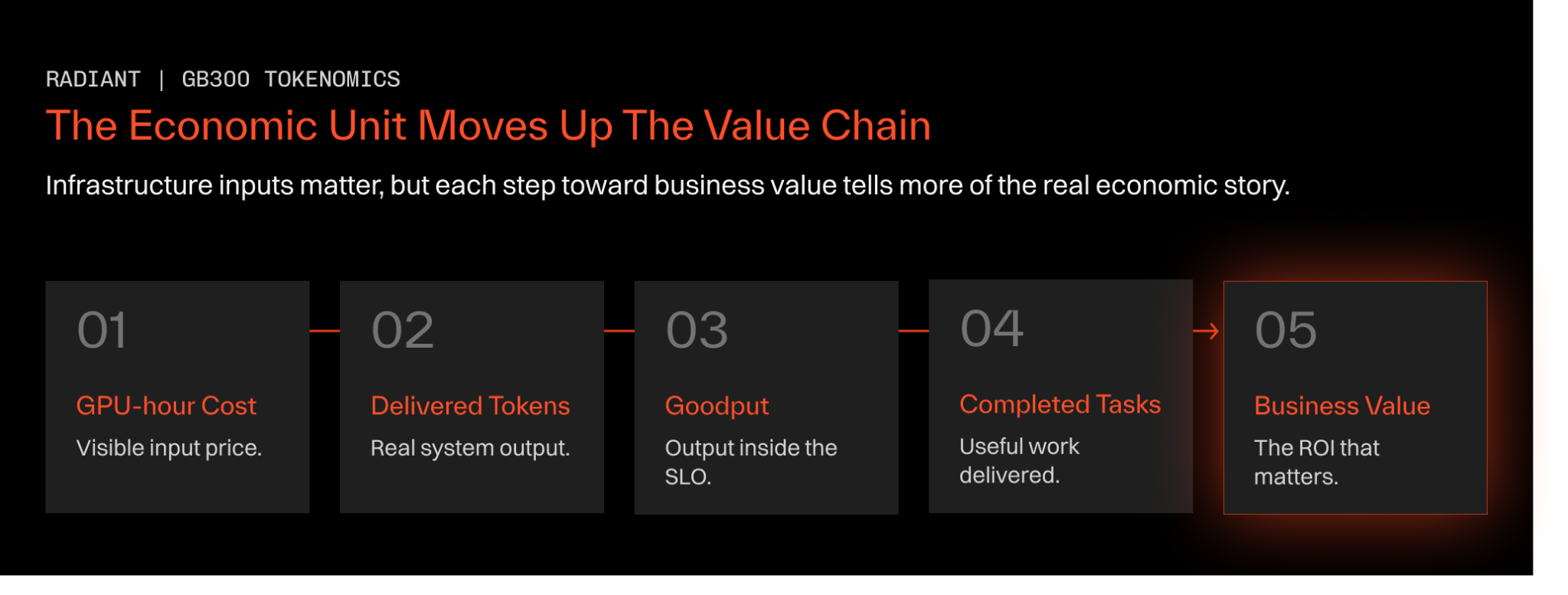
GB300 strengthens this progression at its foundation. By producing more tokens per GPU hour and megawatt, it expands the capacity available for completed work and business value. The first step in that progression, from GPU-hour cost to delivered tokens, is also where GB300’s economic advantage becomes easiest to quantify.

From GPU-Hour Price to Token Cost
Infrastructure buyers have traditionally focused on hourly rental rates, peak compute, HBM capacity and FLOPS per dollar. These measures remain useful, but they describe the resources entering the system rather than the intelligence coming out. NVIDIA has advocated for a better way to articulate value by calculating cost per million tokens:
Cost per million tokens = GPU cost per hour ÷ (delivered tokens per GPU per second × 3,600) × 1,000,000
GPU cost per hour is the numerator, while delivered token throughput is the denominator. If throughput increases substantially faster than the hourly price, the cost of producing each million tokens falls. GB300 changes the economics by expanding this denominator: it delivers considerably more output from each GPU and megawatt, allowing a higher-value accelerator to produce intelligence at a lower unit cost.
NVIDIA’s DeepSeek-R1 comparison illustrates the point. Under the cited operating condition, the assumed GB300 GPU-hour cost is almost twice the H200 cost, while NVIDIA reports roughly 65 times more delivered tokens per second per GPU and 50 times more tokens per second per megawatt. Cost per million tokens falls from $4.20 to $0.12.
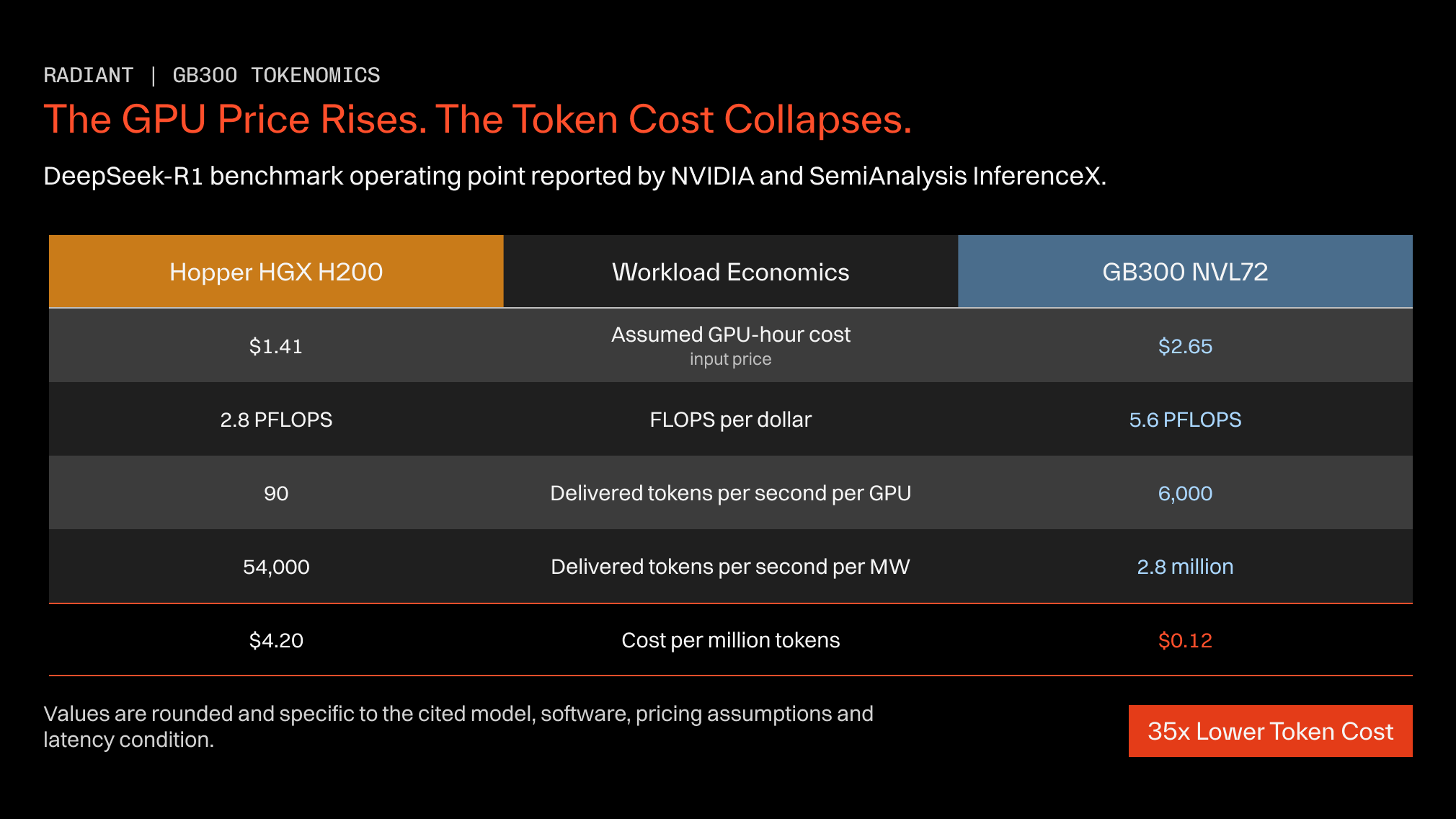
The comparison shows why the cheapest GPU hour is not necessarily the cheapest inference. A higher-value GPU can lower total cost when its additional output substantially exceeds the difference in hourly price, allowing more requests to be served within the same power envelope and service-level target. GB300’s advantage therefore lies in intelligence delivered, concurrent users served and interaction cost.
GB300 Advances Performance per Watt Across Models
Tokens per megawatt is becoming one of the most important measures in AI economics because power increasingly defines the ceiling on deployment. An AI factory cannot produce more intelligence than its electrical and thermal systems can sustain.
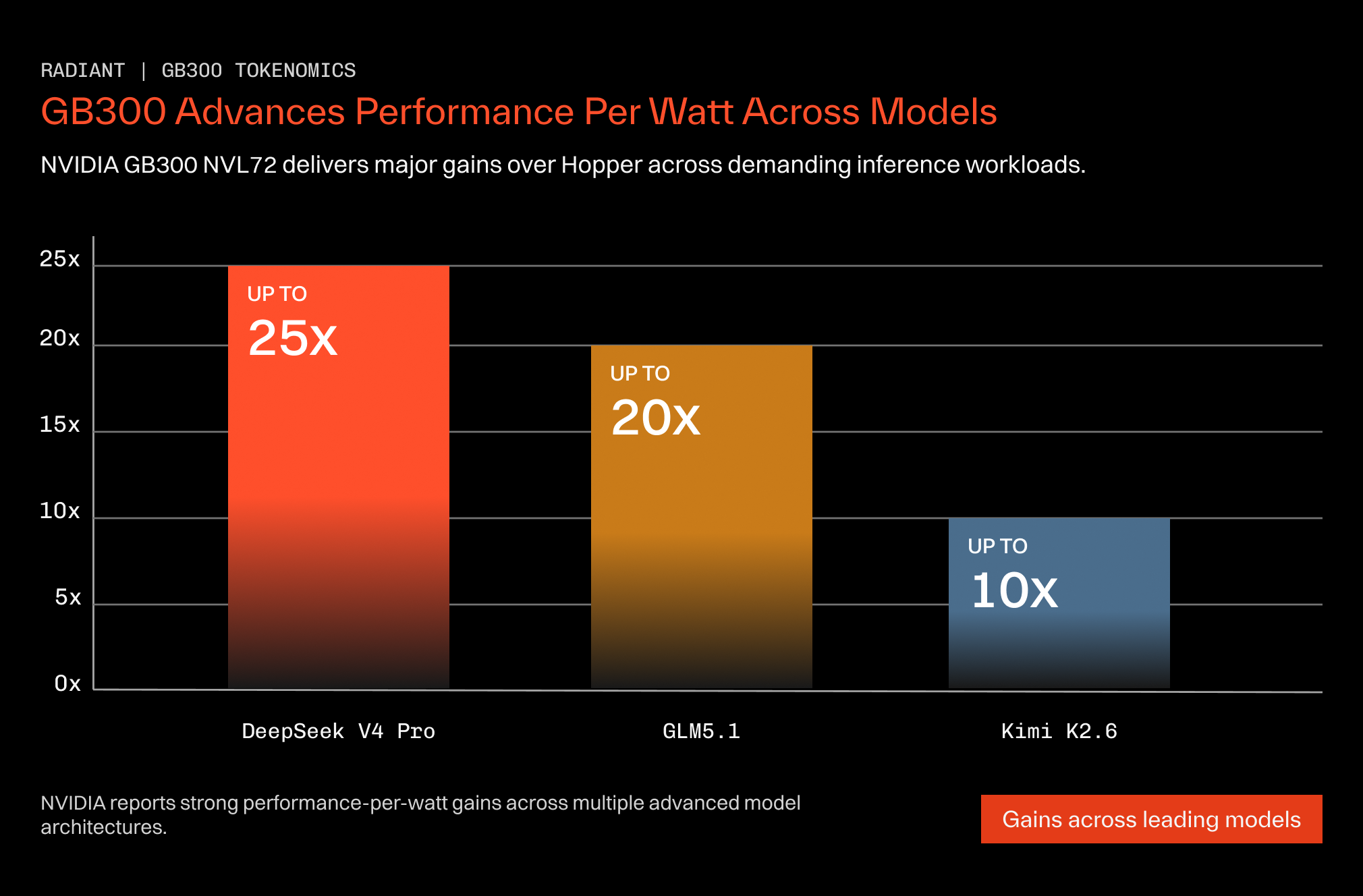
GB300 NVL72 delivers up to 25 times Hopper’s performance per watt on DeepSeek V4 Pro, up to 20 times on GLM5.1 and up to 10 times on Kimi K2.6.
These results span different operating points because production inference must balance throughput with latency, whether the workload is high-volume offline processing or an interactive agent executing a series of dependent steps.
The megawatt consequently becomes a production asset, defined by the useful, latency-compliant intelligence it can support. NVIDIA is extending this efficiency work beyond hardware. Its DSX MaxLPS framework targets cooling and rack-level inefficiencies through dynamic power allocation, warm-water liquid cooling and power steering, enabling operators to run up to 40% more GPUs within the same power budget.
What GB300 Unlocks for Your Workloads
For customers deploying GB300 clusters, the benefits are extensive:
- Run more ambitious AI workloads. Higher output density supports larger models, deeper reasoning, more capable agents and greater concurrency without a proportional increase in infrastructure.
- Lower the cost of production AI. More output from each GPU hour reduces the unit cost of serving high-volume inference and agentic workloads.
- Improve return on deployed capital. Greater productivity per rack helps customers convert infrastructure investment into more usable capacity and faster business value.
- Advance sustainable AI. Higher performance per watt reduces the energy required for each unit of intelligence, helping customers scale AI within available power and cooling capacity.
- Gain predictable access to capacity. Dedicated GB300 clusters provide greater control over performance, optimization, data location and workload scheduling.
- Increase value over time. NVIDIA’s continuing software optimizations improve the productivity of installed infrastructure throughout its operating life.
- Turn infrastructure performance into business outcomes. The strongest economics come from translating higher token output into completed tasks, better services and measurable returns.
Translate GB300 Performance into Production Results
Moving up that ladder requires more than deploying faster hardware. NVIDIA’s performance results are substantial, but they must ultimately be mapped to the operating conditions of each production workload. The model, quantization, context length, concurrency, cache-hit rate and latency objective should resemble the intended application. Time to first token and inter-token latency need to be evaluated alongside throughput and translated into goodput.
Quality must remain connected to token efficiency, since a cheaper answer can become more expensive through retries or escalation. Power, cooling, networking, storage, scheduling and recovery also affect how much of the underlying performance becomes useful output.
NVIDIA’s software stack keeps improving after deployment. The enhanced value from GB300 also demonstrates how optimized runtimes, the latest kernels and model-specific recipes can increase productive output beyond the day-one specification. This is the difference between installing a rack and realizing the full value of an AI factory.
Looking Ahead at Vera Rubin and the Next Evolution of AI Economics
As NVIDIA’s next generation of GPUs, Vera Rubin reaches broader availability in 2027, it is expected to continue the substantial performance and efficiency gains established by Blackwell. At the center of Vera Rubin is a system-level approach to performance. Faster memory and interconnects keep models and data moving efficiently, while the Vera CPU handles more of the orchestration behind AI agents. Co-packaged optics (CPO) integrates optical connectivity directly into the networking system, reducing power requirements and improving reliability as AI factories grow.
According to NVIDIA, Vera Rubin NVL72 will train large mixture-of-experts models with fewer GPUs and reduce inference cost per million tokens by up to 10x compared with Blackwell. Together, these advances reflect the broader evolution of AI compute: each generation delivers greater capability with fewer resources, making AI progressively more economical to build and operate.