There is a growing tendency in the AI infrastructure world to use the terms private cloud, dedicated infrastructure, and AI factory synonymously. In practice, these terms are not interchangeable. They describe different aspects of infrastructure architecture and operation. Knowing the distinctions matters because each model solves a different problem, and the underlying decision to go for one or the other has implications as to what the solution will achieve for the business. Rather than leaving things to chance, understanding the differences will help guide strategic technology decisions and achieve the best possible outcomes.
One refers to an operational model. One refers to a resource tenancy model. One refers to an integrated industrial-scale system.
In our previous article, we pointed out that the private cloud is increasingly characterized not only by isolation but by control and determinism. This is even more relevant in the context of AI.
In this new article, we will dive into each of these terms and highlight the underlying assumptions they encapsulate.
Three Distinct Models
The conflation of models happens because these three concepts can, and often do, co-exist. A company may operate a private cloud, on dedicated infrastructure, within an AI factory construct. As such, even though they describe different characteristics of a system, they are not mutually exclusive.
Using them as synonyms creates a blind spot regarding the architectural trade-offs brought up by modern AI workloads.
What Private Cloud Really Means
The concept of private cloud is not outdated. I recently wrote an entire post about it. The explosive growth of AI workloads and, subsequently, the financial impact associated with the surge in computing resources consumption, brings the topic at the forefront of the discussion.
Private cloud is first of all an operational model. Historically, private cloud emerged as a response to enterprise concerns around compliance, security, governance, operational consistency, and workload locality. It describes infrastructure that offers cloud-like capabilities in an environment where an organization has significant control over infrastructure behavior, locality and dependencies.
Importantly, private cloud does not inherently describe the ownership model, hardware tenancy, physical topology, or performance characteristics. Indeed, a private cloud may run on shared infrastructure or dedicated infrastructure. It may run on bare metal or virtualized environments. It may span multiple data centers or incorporate public cloud services.
By putting the operational abstraction and control model at the core of the technology choice, the private cloud model enables enterprise operators to standardize their compute platforms for both their internal and end-user facing needs. It helps them establish consistent and reliable governance and operational models, and provide the necessary tools to satisfy auditing and regulatory compliance requirements.
In light of new regulatory requirements (such as the EU Cloud and AI Development Act) and the public legitimate concerns surrounding ethical AI, the private cloud model has an important role to play in supporting operators’ objectives.
What Dedicated Infrastructure Really Means
Dedicated infrastructure refers to a tenancy and resource allocation model. It implies that infrastructure resources are physically dedicated to one organization, workload domain, or operational boundary. In practice, dedicated infrastructure means physically separated clusters (dedicated GPU nodes, isolated network fabrics, reserved storage resources…) and customer-specific security domains.
Dedicated infrastructure earns its premium by removing the variables that may negatively impact AI economics. It solves for physical isolation, which typically proves useful for performance predictability and security.
Large-scale training and inference environments are often highly sensitive to network or storage contention, scheduling interference, and noisy-neighbor effects. As a result, many organizations deploying AI at scale increasingly prefer dedicated environments, particularly in highly-regulated industries that require real-time, predictable, and almost deterministic outputs.
Similarly, several sensitive workloads (for instance in the defense industry) demand the infrastructure is air-gapped and completely unreachable by outsiders. Under such circumstances, dedicated infrastructure with their supporting high-security facilities are unavoidable.
Achieving this level of predictability or security does not mean the infrastructure is efficient. A dedicated cluster can be suboptimal for AI. This need for efficient, purpose-built AI systems led the industry to coin the concept of AI Factories.
What an AI Factory Really Is
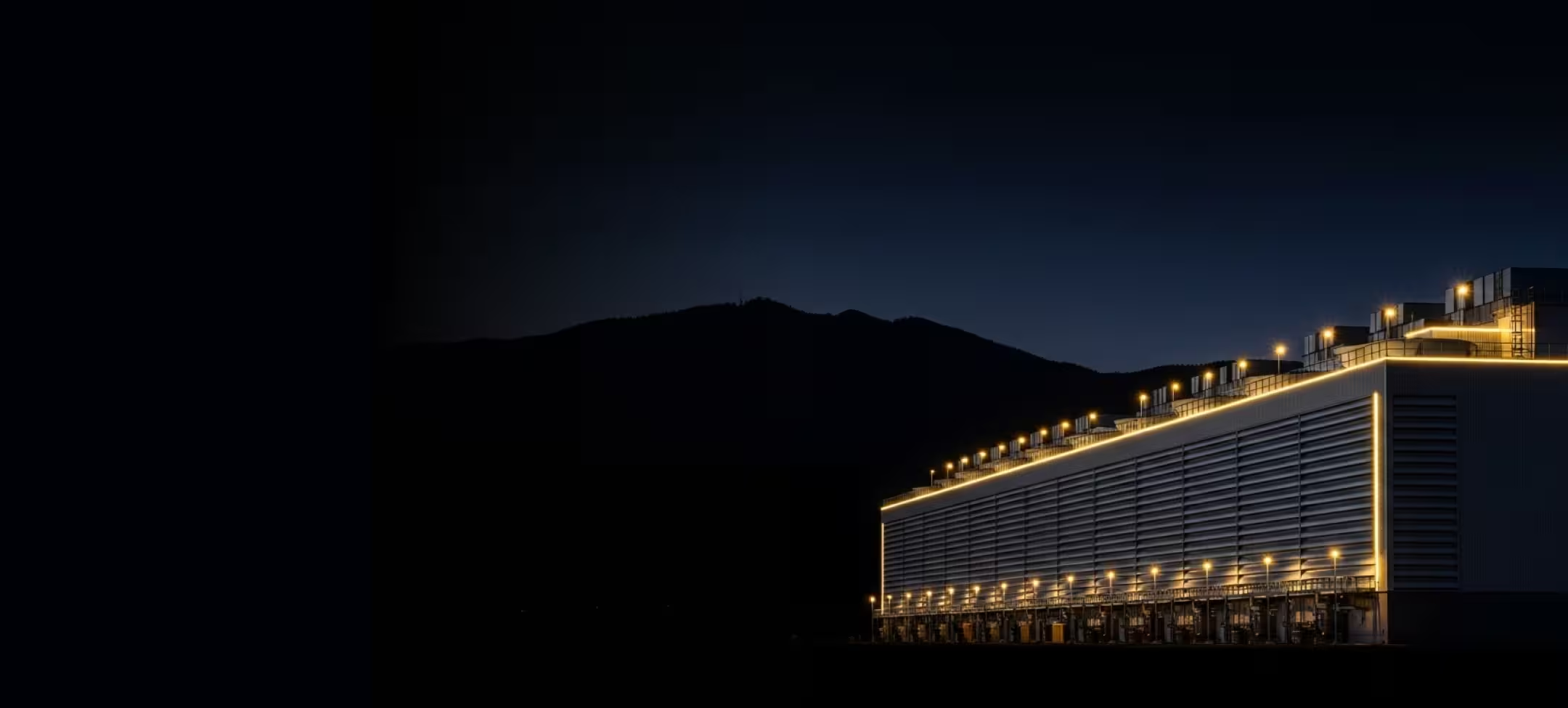
An AI Factory is not simply a GPU cluster, nor is it a dedicated environment with accelerators attached. It is a vertically integrated, coherent industrial platform that combines datacenter facilities, infrastructure, software stack, and services for a single purpose: produce intelligence to help advance the greater good.
AI factories are not just built around compute integration. They are built around a wider system integration with a view of enabling economical and social value with sustainability and societal values in mind. This is a very important distinction that Radiant is hyper-focused on.
At its foundation, AI factories are built within facilities that concentrate vast, high-density power and cooling systems. The use of renewable and sustainable energy, efficient hardware equipment, combined with a balanced architecture and purpose-built software stack helps maximize the efficiency and output per Watt of AI workloads. Setting these values at the core of our designs and deployments is essential to holistically support the whole raison-d’etre of AI factories.
The software stack deserves its special mention. All AI workloads are not equal. To maximize both efficiency and utilisation, an intelligent and purpose-built software stack is required. The two key roles of the cloud operating system is to re-purpose the underlying infrastructure based on the workloads’ demand, and to optimize scheduling needs through the use of advanced orchestration algorithms.
Combined with the right services and domain-level white glove services, AI factories are the power tools needed to harness this new form of powered intelligence.
Where Each Model Applies
These three models are not competing philosophies. They solve different challenges. Private clouds are extremely efficient for operational control, governance and regulatory compliance. Dedicated infrastructure should be considered whenever organizations require physical isolation, primarily for the sake of security and predictable performance. Weaving in the principles of AI factories is necessary when it is established that the projects are built for the purpose of AI, where industrial-scale operational efficiency, social, and ethical considerations come into play.
For the last fifteen years, cloud infrastructure has been evolving toward abstraction. Infrastructure became more software-defined, more virtualized, more decoupled from physical topology. AI changes this trend.
Modern AI workloads reveal physical aspects of infrastructure that abstraction layers were built to hide. Things like power delivery, thermal density, interconnect topology, storage throughput, scheduling locality, and operational coordination.
None of this means the private cloud is going away. It means infrastructure architecture is increasingly constrained by systems engineering considerations, in addition to software ones.
The industry is not moving away from cloud principles. It is moving toward environments where abstraction alone is no longer enough.
That is why the difference between private cloud, dedicated infrastructure, and AI factories matters now. They are not interchangeable terms. They represent different aspects of modern AI infrastructure, and treating them as the same thing produces architectural decisions that are wrong in costly ways.