
.png)
At AI factory scale, resilience cannot be added after the cluster is live. It has to be designed into how the GPU estate is deployed, monitored, maintained, and returned to service.
That is how Radiant deploys large GPU clusters. Breakfix is not treated as a disconnected support workflow. It is built into the operational fabric of the AI factory, alongside scheduling, maintenance intelligence, hardware diagnostics, firmware visibility, and lifecycle control.
This is not just a theoretical concern. Large-scale training environments are already showing how quickly reliability becomes a fleet-level operating challenge. Meta analyzed 11 months of production data across two large ML clusters, covering 4 million jobs and more than 150 million GPU hours. The study shows that reliability at AI factory scale is shaped by a combination of job size, scheduler behavior, health checks, node reuse, software remediation, and hardware state.
The effect becomes sharper as clusters scale. In the same study, a 1,024-GPU job had a mean time to failure of 7.9 hours, compared with 47.7 days for an 8-GPU job. This reinforces a practical deployment principle: Large GPU clusters need more than accelerators, networking, and power. They need built-in breakfix capabilities that allow administrators to identify risk, isolate affected capacity, act at the right layer, and return trusted nodes back into production.
Resilience begins with the breakfix lifecycle
In traditional infrastructure, breakfix often starts when something has already failed. In GPU fleets, that approach is too slow. Nodes, GPUs, network adapters, NVSwitch trays, fans, firmware versions, and rack-level dependencies all need to be understood as part of one operating system. With the right telemetry, alerting & diagnostic logs, operators can identify risks early and act before they become customer-impacting outages.
A resilient breakfix lifecycle should allow operators to take targeted actions at the right layer:
Compute-level recovery
Power-cycle individual nodes or reset virtual machine instances when the issue can be resolved without broader disruption.
GPU-level intervention
Reset GPUs on an individual node when accelerator-level faults occur, especially in Kubernetes environments where workloads need to be rescheduled cleanly.
Maintenance workflows
Return or report a specific node or rack to the provider for maintenance, with enough context to avoid slow, back-and-forth troubleshooting.
Cordon before disruption
Mark a node as unschedulable for new workloads while allowing existing workloads to finish, reducing unnecessary interruption.
Replace when thresholds are breached
Trigger host replacement when health thresholds indicate that continued operation could compromise performance or reliability.
The goal is not to treat every hardware issue the same way. The goal is to make breakfix precise. A faulty GPU should not automatically imply a rack-level incident. A maintenance event should not create unnecessary workload churn. A degraded node should be isolated before it affects the wider fleet.
Radiant Deploys Clusters with Breakfix Built in
In conventional infrastructure, a node issue can often be treated as a local incident. In a large GPU cluster, that assumption breaks down. Distributed AI workloads require many nodes, GPUs, network paths, and software layers to work together. When one part of the allocation becomes unhealthy, the impact can extend beyond the individual machine.
That is why Radiant deploys GPU clusters with targeted breakfix controls from the start. Operators can power-cycle an individual node, reset a VM instance, reset GPUs on a specific node, return or report a node or rack for maintenance, cordon a node from new workloads, and request host replacement when health thresholds are breached. These are not generic support actions. They are operational controls designed for live AI factories where each action must be applied to the right layer to protect workload continuity.
That operating discipline comes together in Radiant FlightDeck, the operational plane Radiant uses to observe and operate AI infrastructure across capacity, health, topology, maintenance, audit, and lifecycle state. FlightDeck spans data centers, AI hardware, compute services, and managed services, giving Radiant one operating surface for the full AI factory.
How Radiant Operationalizes Fleet Resilience
Maintenance becomes part of the control plane
Health checks are a first-line defense, from GPU errors, filesystem mounts, service status, PCIe issues, InfiniBand link errors, NVLink errors, uncorrectable ECC, failed row remaps, and other infrastructure signals. High-severity checks can remove nodes and trigger rescheduling, while lower-severity issues can remove nodes for remediation after current jobs finish.
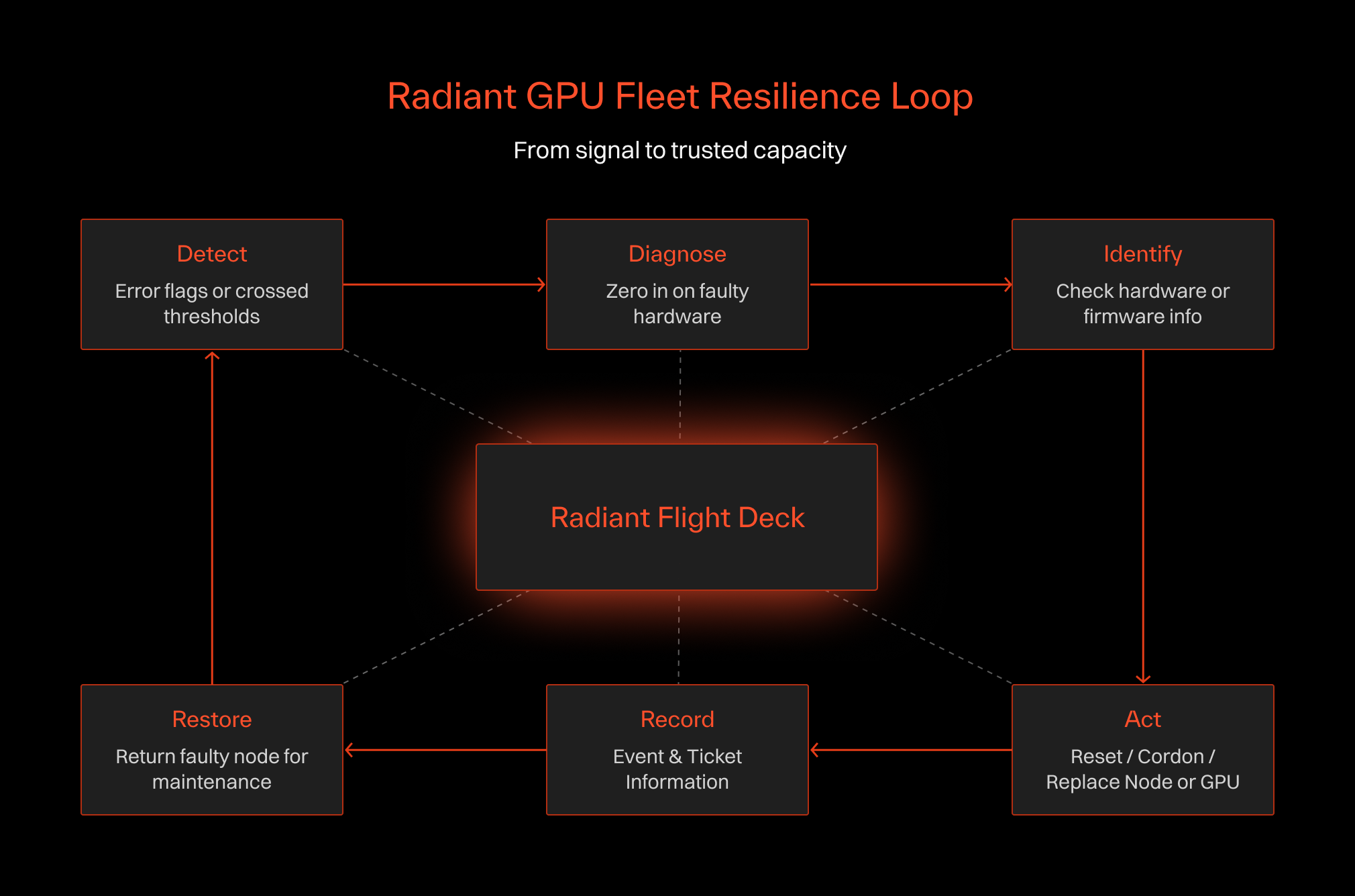
The fleet resilience loop above captures how Radiant runs large GPU clusters in production: sense fleet signals, triage the affected node or component, act through reset, cordon, or replacement workflows, log the action, verify hardware and firmware state, and return trusted capacity to service.
Maintenance with Radiant is not just a ticketing process. It becomes queryable infrastructure data. Radiant Flight Deck enables fleet administrators to query upcoming and current maintenance events for a node or rack, check retirement notices, and review historical repair or status information.
Because these steps are connected, remediation is not separate from operations. Capacity moves back into production only when it is visible, diagnosable, and trusted by the AI factory operating model.
Hardware identity makes remediation faster
Radiant’s deployments also include the hardware visibility needed to diagnose issues precisely. Operators can identify installed hardware across chassis, baseboard, network adapters, CPUs, GPUs, and related components. Where serial numbers are obfuscated, stable identifiers still provide continuity across maintenance and repair workflows.
That matters because infrastructure symptoms are often ambiguous. A stalled job or slow node may point to GPU memory, PCIe, firmware, interconnect, storage, or system software. Without asset-level context, teams can lose time chasing the most visible symptom rather than the underlying cause.
Radiant treats each node as a physical and logical asset with its own component profile, firmware state, maintenance history, and scheduling context. That makes remediation faster and reduces the risk of returning questionable capacity to production too early.
Diagnostics go below surface-level health
A GPU cluster can appear available while still carrying operational risk. Firmware drift, NVSwitch inconsistencies, GPU memory errors, PCIe issues, link instability, and degraded components may only surface under heavy workloads.
Radiant deploys diagnostics that expose this deeper layer. Operators can inspect firmware versions across compute nodes and NVSwitch trays, alongside hardware inventory and stable identifiers. That context helps determine whether a node should be reset, cordoned, repaired, replaced, or returned to service.
The objective is not just to react when something breaks. It is to prevent risky capacity from taking new work until it is trusted again.
From breakfix to production readiness
From having operated high-performance GPU clusters over the years, our team recognizes that reliability cannot be solved by one mechanism. Health checks matter. Scheduling, checkpointing, hardware diagnosis, and remediation workflows all play a role, as does the ability to separate short-lived anomalies from signs of persistent degradation.
Radiant brings these concerns into the way it deploys large GPU clusters. Breakfix events become structured records. Maintenance becomes queryable. Nodes can be cordoned before they accept new workloads. GPUs can be reset at the right layer. Hosts can be replaced when thresholds are breached. Firmware and component identity can be inspected before small inconsistencies become larger operational issues.
At AI factory scale, production readiness is not defined by how many GPUs are online in theory. It is defined by how consistently those GPUs can be trusted, scheduled, maintained, remediated, and returned to service. Radiant deploys large GPU clusters with that discipline built in, so AI factories can move from raw capacity to reliable production infrastructure.