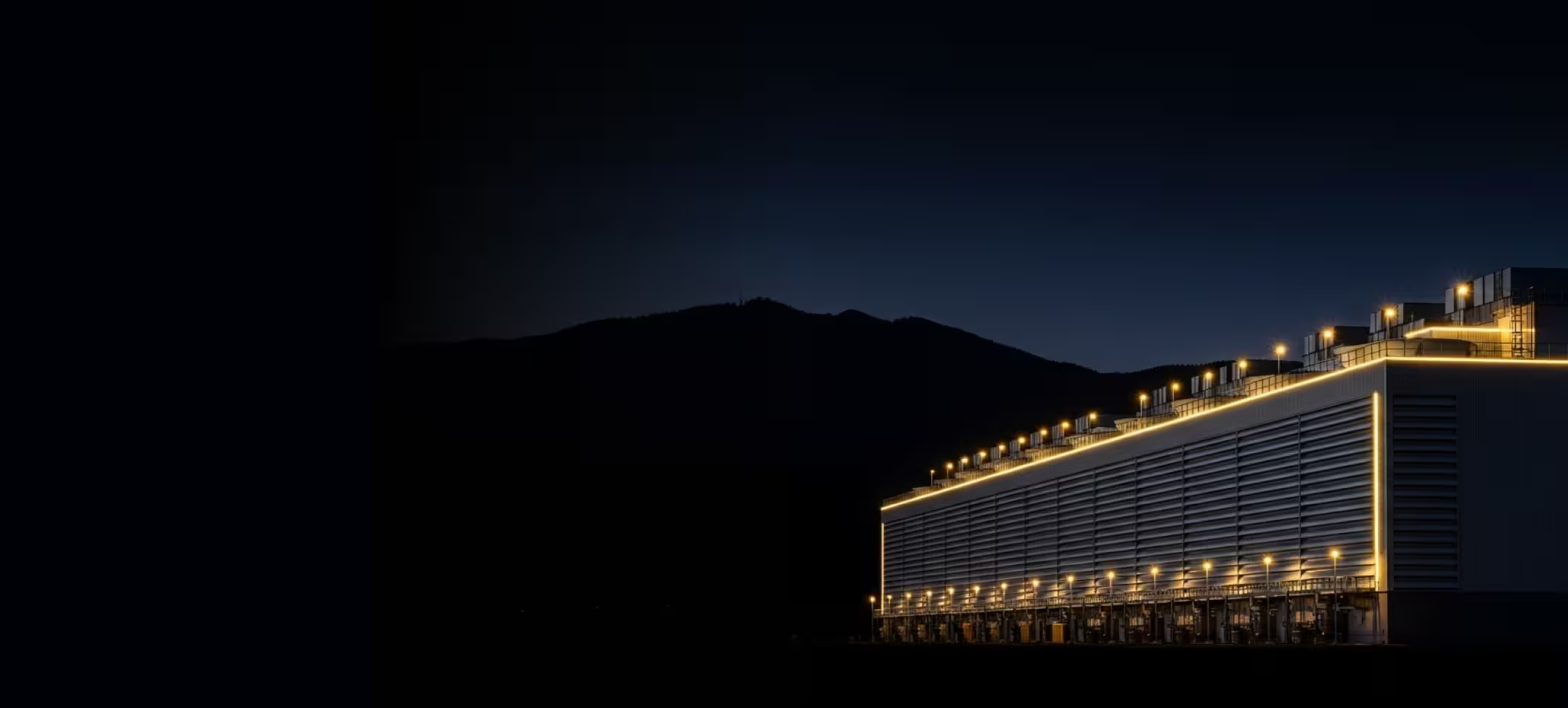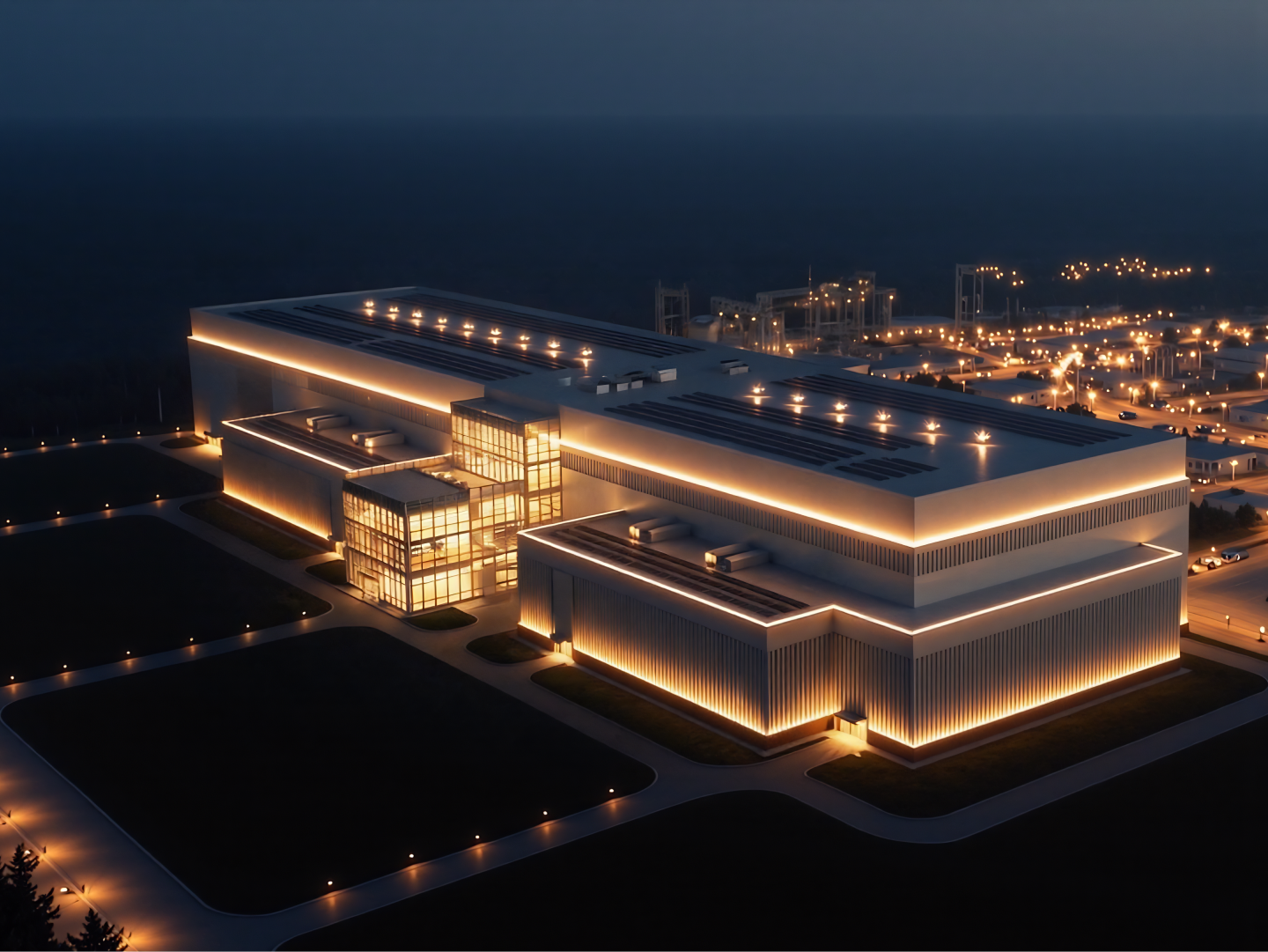

Whilst reconnecting with old colleagues and hearing introductions from new acquaintances, there is a shared view that most of us fell into the world of data centres often more by accident than purpose. Often labelled as a warehouse for computers, the traditional DC has not always been as exciting as other Core or Core + infrastructure classes, but AI infrastructure is entirely different. An AI Factory is more akin to an industrial power plant that computes.
This changes the game considerably when it comes to building one.
The value does not lie solely in: the land, the power, the compute or the software - it lies in the strategic integration of these disparate, high-stake variables.
To understand why a vertical approach is a viable path forward, we must look at the compounding complexities they present and how a single entity with full visibility, ownership and flexibility to integrate these component parts provides a key strategic advantage to accelerate success in the AI Factory model at true scale.
I. The "Three-Body Problem" of Infrastructure
In physics, the "Three-Body Problem" refers to a system where three different forces act on each other in a way that makes the outcome nearly impossible to predict. AI infrastructure faces a similar gridlock - if you’ll pardon the pun. To build an AI Factory, you need three core ingredients to align perfectly:
- Land Entitlement: You don't just need acres of land; you need acres of land that key, local regulatory stakeholders allow you to develop for data centres. In some regions, those stakeholders have become skeptical of data centre development, meaning zoning, permitting and planning processes are taking longer and becoming more challenging to navigate. The industry has taken time to adapt to key sustainability criteria; renewable power usage, circular economy, heat re-use, PUE, WUE, noise etc.
- The Power Queue: Local grids are aging, overstretched, costly to upgrade and fundamentally not equipped to distribute the abundance of generated power that is actually available. In many regions:
- The lead time to procure a high-voltage connection is now 4 to 7 years;
- There are several hundred applications for power ahead of you in the queue
- The lead time to procure transformers and step down from high-voltage to medium voltage can add another 2 years to your critical path.
- The Connectivity Nexus: Data centers require redundant and often low-latency connectivity (multiple physical routes of fiber-optic cable that connects the site to the rest of the global internet), of which, competition is higher than ever and bringing fibre to remote and rural land parcels where there is power and less regulatory constraint is both costly and time consuming.
The Complexity Compound: If you secure the land but miss the power window, your land is worthless. If you get the power but the local community votes against your zoning, your investment is stranded. A horizontal approach (trying to secure each aspect sequentially) is a riskier approach because any one delay breaks the entire chain. Having the agility to integrate these core components vertically allows you to pivot and react.
II. The Power Sovereignty Shift
Historically, data center developers were "customers" of the utility company. They build a shell and wait for the power company to plug them in.
That model is dead. Recent publications from Goldman Sachs and CBRE note that almost all US power grids will lack critical spare capacity by 2030. This creates a "vertical" necessity:
- Behind-the-Meter Generation: Leading developers are no longer just buying power; they are building it. This includes on-site natural gas turbines, modular nuclear reactors (SMRs), or massive solar arrays.
- Substation Control: By designing and building their own high-voltage substations—a task usually left to utilities—firms like Radiant can shave years off their "time to market."
III. The "Social License" as a Technical Barrier
For reasons that are both rational and irrational, we are in an era "Not In My Backyard" when it comes to AI datacenters. There is validity to the opposition in some cases. Water use, power consumption and noise are by-products of any sufficiently large envelope.
A vertical approach treats community relations as an engineering requirement. It pays attention to resource consumption concerns and mitigates them with transparent solutions.
Integrated Zoning: Instead of fighting a town over a single building, vertical developers utilize integrated zoning. They build the roads, the green buffers, and the power infrastructure for the whole area, making it a "packaged deal" that is easier for local governments to approve:
- Infrastructure Subsidies: The developer builds the high-capacity roads, the green buffers, and the specialized power substations that would otherwise strain the town's budget.
- Resource Decoupling: By engineering private water treatment or securing "behind-the-meter" power generation, the developer can prove to the community that the data center isn't "stealing" their lights or their water.
- Predictable Envelopes: A master plan gives local governments a 10-to-20-year roadmap. This level of transparency reduces the "fear of the unknown," turning a series of potential political battles into a single, comprehensive industrial agreement.
A horizontal developer - someone who buys land and hopes a utility will show up - cannot make these promises. They are at the mercy of third parties. A vertical developer, however, controls the power, the water, and the construction timeline. This allows them to guarantee the mitigation strategies they promise the municipality. In the race for AI space, the winner isn't just the one with the land; it’s the one who has engineered a path to "Yes" from the local community.
IV. The Institutional Moat: De-Risking for Long-Duration Capital
The true unlock for GW+ compute projects requires the transition from Speculative Real Estate to Core Infrastructure. If you can execute on the above, you can apply infrastructure capital to the problem. That capital is cheaper, has longer duration and more patience.
In a horizontal development chain, risk is fragmented. The land owner waits for the utility; the utility waits for the regulator; the builder waits for both. For long-duration capital, this "interdependency" is a red flag. If the power delivery slips by 18 months, the internal rate of return (IRR) collapses, and the project becomes a stranded asset. Horizontalism creates Termination Risk: the danger that a project fails simply because three different companies couldn't synchronize their watches.
Vertical integration is a financial engineering tool. By bringing the land, the power interconnection, and the construction under one roof, the developer "internalizes" the friction. This creates a Compressed Risk Profile that allows for sophisticated financing structures:
- Execution Certainty: When the developer owns the substation and the "behind-the-meter" generation, the "Date of Occupancy" is no longer a guess—it’s a guarantee. Infrastructure funds will accept lower yields in exchange for this level of certainty.
- Asset-Backed Stability: "Adult Capital" prefers assets that look like utilities. A vertically integrated data campus—complete with its own roads, power infrastructure, and water rights—is a "Sovereign Industrial Island." It is an essential utility that generates predictable, long-term cash flows, making it eligible for the deepest pools of global capital.
- Decoupling from the "Cycle": Because the developer controls the entire stack, they aren't at the mercy of localized construction bottlenecks or utility rate hikes. They have built a "moat of autonomy" that protects the capital from external market volatility.
Summary: The Ultimate Synthesis
In the world of massive-scale infrastructure, control is the ultimate currency. By solving the "Social License" as an engineering requirement and the "Power Queue" as a technical milestone, the vertically integrated developer creates an asset that is ready for the most patient, most powerful capital on the planet. They aren't just building a place for servers; they are building the Industrial Backbone of the 21st Century, engineered for scale and financed for the long haul.