

The NVIDIA Hopper GPUs have been pivotal in advancing Generative AI, with the H100 GPU setting new benchmarks for training and deploying large models. But as AI continues to push boundaries, bigger models demand even greater performance and memory capacity. Enter the NVIDIA H200 GPU—a powerhouse designed to meet the needs of the next generation of AI. Driven by significant memory enhancements, the H200 GPU makes AI training and inference faster, helping you optimize your GPU fleet to run larger workloads. Whether you're training very large models or scaling inference to thousands of users, the H200 delivers superlative performance and efficiency, paving the way for widespread AI adoption.
Understanding the NVIDIA H200 Specifications
The H200 GPU is available in two form factors: SXM and NVL. Here's a snapshot of the NVIDIA H200 specs:
The NVIDIA H200 SXM delivers up to 18% higher performance over the NVL form factor with a higher Thermal Design Power (TDP) of 700W. The SXM variant comes with options of air and liquid cooling whereas NVL is air-cooled only. The H200 NVL GPU uses a 2- or 4-way NVLink bridge for GPU interconnect, whereas the H200 SXM uses point-to-point NVLink which makes large scale cluster deployments more seamless.
What can you do with the NVIDIA H200 GPU?
Train & finetune large models: The faster and expanded NVIDIA H200 memory enables improved training and inference for state-of-the-art (SOTA) models. Whether you are building foundation models or training compute-intensive models such as image and video generation, H200 GPUs are a great choice for models that are trained on vast amounts of data.
Run inference on 100+billion parameter models with ease: The enhanced HBM3E memory capabilities of the H200 GPU makes it easier to run inference with much longer input and output sequences with tens of thousands of tokens. That means you can serve your models at scale with low latency for a superior user experience.
Power high-precision HPC workloads: Whether it is scientific models, simulations or research projects, increased memory capacity helps to run models with higher precision formats such as FP32 and FP64 for maximum accuracy, and higher memory bandwidth reduces computing bottlenecks.
Deploy Enterprise AI with greater efficiency: Enterprise AI apps typically run on large GPU clusters, the H200 GPU makes it easy to manage infrastructure with fewer GPUs, greater utilization and enhanced throughput for better ROI.
What are the key differences between the H100 and H200 GPUs?
An important hurdle to advancing AI progress is the memory wall. Model attributes such as accuracy, sequence length and latency are either directly or indirectly influenced by memory bandwidth and memory capacity of GPUs. Ample and fast memory is an essential requirement to realize the full computational benefits of a high performance GPU architecture such as Hopper.
The H200 GPU has 76% more memory (VRAM) as compared to the H100 and 43% higher memory bandwidth which makes it easier to accommodate larger models in memory and also improves latency especially for inference, allowing models to make better use of the advances in the NVIDIA Hopper architecture. The newer HBM3E memory architecture in H200 packs 6 stacks of 24 GB when compared to 5 HBM3 memory stacks of 16GB in H100, making the memory more dense.
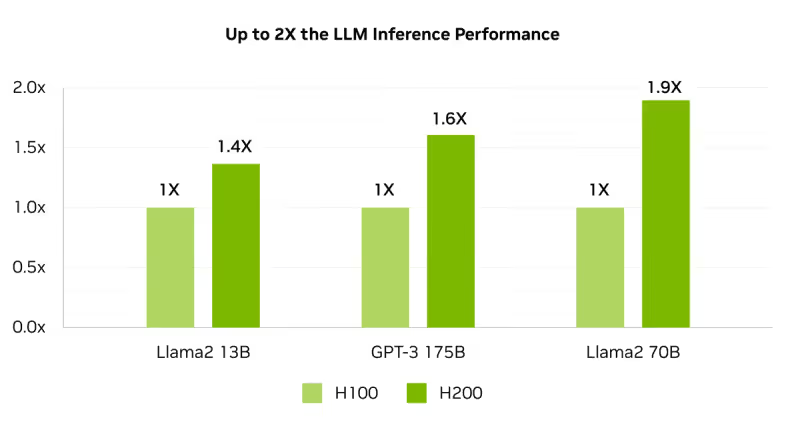
The H200 Tensor Core GPU maximizes the Hopper architecture performance with larger and faster HBM memory access, making AI inference up to 2 times faster. The larger memory capacity also helps run parameters with higher parameter count on the H200 GPU, which otherwise would not be possible on the H100 GPU. For example, Llama 3.2 90B needs 64GB of memory to run with Ollama, without accounting for dependencies.
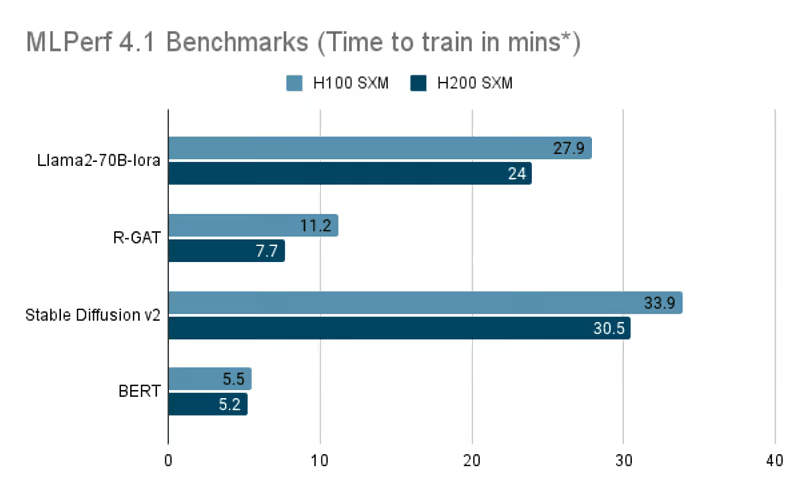
MLPerf 4.1 benchmarks portray faster time to train and fine tune models when compared to NVIDIA H100 Tensor Core GPU.
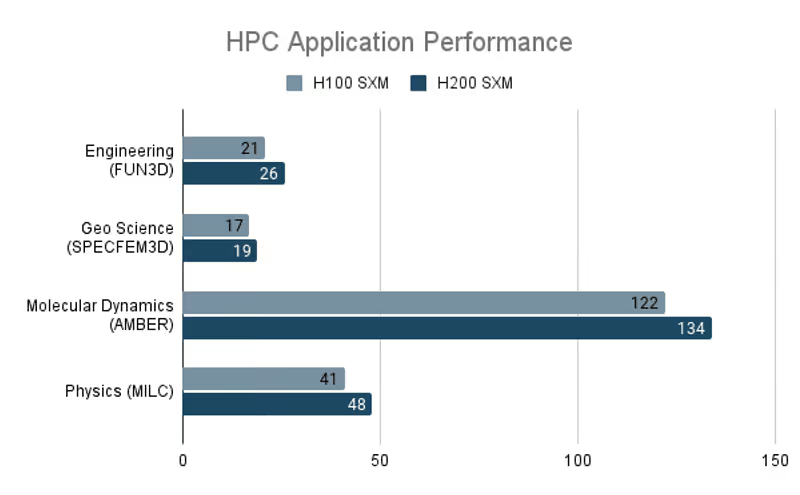
Similarly, high performance computing (HPC) workloads in engineering, molecular dynamics, physics and geographical computing can see performance enhancements with the NVIDIA H200 chip.
Get started with the NVIDIA H200 GPU
Build, scale and serve your most ambitious models with H200 GPUs on Radiant AI Cloud. Radiant provides you three powerful ways of deploying them:
- GPU instances, on-demand virtual machines backed by top-tier GPUs to run AI workloads.
- Serverless Kubernetes helps you run inference at scale without having to manage infrastructure.
- Inference Endpoints deliver fast, scalable and production-grade AI inference